
Wire Size and Amp Chart: Find the Right Wire Gauge for Any Circuit
Pick the right wire the first time. These charts match wire gauge to amps for copper and aluminum, with the common circuits, voltage drop and sizing rules explained.
 By Clement James, Tervano Electric · Twin Falls, Idaho · November 2026
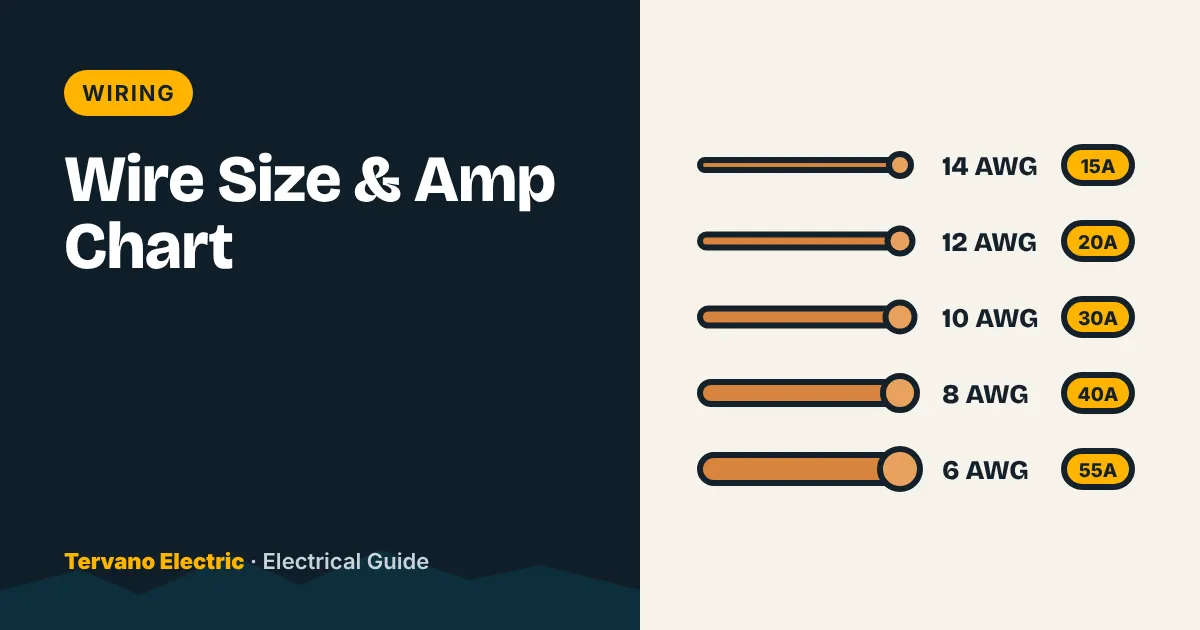
Wire size depends on the amps the circuit carries. For copper in a home: use 14 AWG for 15 amps, 12 AWG for 20 amps, 10 AWG for 30 amps, 8 AWG for 40 amps and 6 AWG for 50 to 55 amps. Aluminum needs one to two sizes larger. Long runs need bigger wire to limit voltage drop. Always match the breaker to the wire, never the other way around.
Safety first. These charts are a guide, not a substitute for the code or an electrician. Wire that is too small for its breaker can overheat and start a fire. Most new circuits need a permit and inspection.
You are wiring a new shop outlet, an EV charger or a hot tub. The breaker says 50 amps. The store shelf has a dozen wire sizes. Which one is right? Pick too small and the wire runs hot inside your wall. Pick too big and you waste money and fight stiff cable all day.
This guide gives you the wire size and amp chart electricians use, explains how to read it and shows the right wire for the most common home circuits. If you would rather have it done for you, our electrical wiring services page explains how a licensed electrician handles new circuits.
What size wire do you need for each amp rating?
For most home circuits, this quick chart gives the minimum copper wire size. It uses the 60°C column for NM-B cable (Romex) and the 75°C column for wire in conduit.
| Breaker size | Copper NM-B cable (Romex) | Copper THHN in conduit | Aluminum (in conduit or SER) | Typical uses |
|---|---|---|---|---|
| 15 amp | 14 AWG | 14 AWG | 12 AWG | Lighting, bedroom outlets |
| 20 amp | 12 AWG | 12 AWG | 10 AWG | Kitchen, bath, laundry, garage outlets |
| 30 amp | 10 AWG | 10 AWG | 8 AWG | Dryer, water heater, small AC |
| 40 amp | 8 AWG | 8 AWG | 6 AWG | Cooktop, some ranges, EV charger |
| 50 amp | 6 AWG | 8 AWG | 6 AWG | Range, hot tub, RV outlet, EV charger |
| 60 amp | 4 AWG | 6 AWG | 4 AWG | Subpanel, large EV charger, tankless heater |
| 100 amp | Not typical | 3 AWG | 1 AWG | Subpanel or detached shop feeder |
How we built this chart: each row uses the smallest wire whose NEC Table 310.16 ampacity meets the breaker size, using 60°C for NM-B cable and 75°C for THHN and aluminum. It assumes no more than three current-carrying conductors and normal temperatures. Long runs, hot attics and bundled cables can require a larger size.
What is the full wire ampacity chart (NEC 310.16)?
Ampacity is the maximum current a wire can carry without overheating. NEC Table 310.16 lists it by wire size, metal and insulation temperature rating.
Copper wire ampacity chart
| Copper wire size | 60°C (NM-B, UF) | 75°C (THWN, most terminals) | 90°C (THHN, derating only) |
|---|---|---|---|
| 14 AWG | 15 A | 20 A | 25 A |
| 12 AWG | 20 A | 25 A | 30 A |
| 10 AWG | 30 A | 35 A | 40 A |
| 8 AWG | 40 A | 50 A | 55 A |
| 6 AWG | 55 A | 65 A | 75 A |
| 4 AWG | 70 A | 85 A | 95 A |
| 3 AWG | 85 A | 100 A | 115 A |
| 2 AWG | 95 A | 115 A | 130 A |
| 1 AWG | 110 A | 130 A | 145 A |
| 1/0 AWG | 125 A | 150 A | 170 A |
| 2/0 AWG | 145 A | 175 A | 195 A |
| 3/0 AWG | 165 A | 200 A | 225 A |
| 4/0 AWG | 195 A | 230 A | 260 A |
Aluminum wire ampacity chart
| Aluminum wire size | 60°C | 75°C | 90°C |
|---|---|---|---|
| 12 AWG | 15 A | 20 A | 25 A |
| 10 AWG | 25 A | 30 A | 35 A |
| 8 AWG | 35 A | 40 A | 45 A |
| 6 AWG | 40 A | 50 A | 55 A |
| 4 AWG | 55 A | 65 A | 75 A |
| 2 AWG | 75 A | 90 A | 100 A |
| 1 AWG | 85 A | 100 A | 115 A |
| 1/0 AWG | 100 A | 120 A | 135 A |
| 2/0 AWG | 115 A | 135 A | 150 A |
| 4/0 AWG | 150 A | 180 A | 205 A |
Values follow NEC Table 310.16 for not more than three current-carrying conductors at 30°C (86°F). Check the edition your area enforces in NFPA 70, the National Electrical Code.
How do you read a wire gauge amp chart?
Find your breaker size, then pick the smallest wire whose ampacity in the correct temperature column meets or beats it. The right column depends on the cable type and the terminals it connects to.
- Know your cable type. NM-B (Romex) and UF cable must use the 60°C column.
- Check the terminals. Most breakers and devices are rated 75°C. Circuits of 100 amps or less use 60°C unless the terminals are marked 75°C.
- Use the 90°C column only for adjustments. It is a starting point for derating, not a final rating.
- Apply corrections. Hot attics, rooftops and more than three conductors in one conduit lower the ampacity.
- Check voltage drop on long runs, covered below.
The small conductor rule
The NEC caps the breaker on small copper wire no matter what the table says. 14 AWG gets a 15 amp breaker, 12 AWG gets 20 amps and 10 AWG gets 30 amps. That is why 12 AWG is always on a 20 amp breaker, even though it is rated 25 amps at 75°C.
What do AWG wire sizes mean?
AWG stands for American Wire Gauge. The smaller the number, the thicker the wire. Sizes above 1 AWG use 1/0, 2/0, 3/0 and 4/0, said "one aught" through "four aught."
| AWG size | Diameter (inches) | Diameter (mm) | NM-B jacket color |
|---|---|---|---|
| 14 AWG | 0.064 | 1.63 | White |
| 12 AWG | 0.081 | 2.05 | Yellow |
| 10 AWG | 0.102 | 2.59 | Orange |
| 8 AWG | 0.128 | 3.26 | Black |
| 6 AWG | 0.162 | 4.11 | Black |
| 4 AWG | 0.204 | 5.19 | Not NM-B colored |
| 2 AWG | 0.258 | 6.54 | Not NM-B colored |
| 1/0 AWG | 0.325 | 8.25 | Not NM-B colored |
Diameters are for a single solid conductor without insulation. Stranded wire and insulation add to the outside size. Above 4/0, wire is sized in kcmil, such as 250 kcmil.
What size wire for common home circuits?
Most home circuits fall into a few standard sizes. Always check the appliance nameplate and install instructions first.
What size wire for 20 amps?
Use 12 AWG copper. This covers kitchen countertop outlets, bathrooms, laundry and most garage outlets.
What size wire for 30 amps?
Use 10 AWG copper. Common for electric dryers, water heaters and small air conditioners.
What size wire for 40 amps?
Use 8 AWG copper. Common for cooktops, wall ovens and many Level 2 EV chargers.
What size wire for 50 amps?
Use 6 AWG copper NM-B cable, or 8 AWG copper THHN in conduit with 75°C terminals. Common for ranges, hot tubs, RV outlets and EV chargers. For the 50 amp outlet itself, see our NEMA 14-50 outlet guide. See our EV charger installation and hot tub electrical pages.
What size wire for 60 amps?
Use 6 AWG copper THHN in conduit, or 4 AWG copper NM-B cable. Common for subpanels and tankless water heaters. Our subpanel installation page covers feeders.
What size wire for 100 and 200 amp service?
For a whole-home service, the NEC allows a reduced size based on 83 percent of the service rating. A 100 amp service commonly uses 4 AWG copper or 2 AWG aluminum. A 200 amp service commonly uses 2/0 copper or 4/0 aluminum. Feeders to a 100 amp subpanel usually need 3 AWG copper or 1 AWG aluminum. Read our electrical panel size guide to choose the right service.
How does wire length change the wire size?
Longer wire has more resistance, so voltage drops along the run. Keep voltage drop under about 3 percent on a branch circuit and about 5 percent total. On long runs, that often means going up one or two sizes.
| Load at 240V | Up to 50 ft | 100 ft | 150 ft | 200 ft |
|---|---|---|---|---|
| 20 amps | 12 AWG | 12 AWG | 10 AWG | 10 AWG |
| 30 amps | 10 AWG | 10 AWG | 8 AWG | 8 AWG |
| 40 amps | 8 AWG | 8 AWG | 6 AWG | 6 AWG |
| 50 amps | 6 AWG | 6 AWG | 6 AWG | 4 AWG |
How we built this table: copper conductors, one-way distance, full load and about 3 percent drop at 240 volts. At 120 volts the drop doubles in percentage terms, so long 120 volt runs need bigger wire sooner. For an exact answer, use a calculator such as the Southwire voltage drop calculator.
Long runs matter most for detached shops, well pumps and outbuildings. See our shop and garage electrical page and our guide to well pump electrical problems.
Copper vs aluminum wire: which should you use?
Copper carries more current for its size and is standard for branch circuits. Aluminum is lighter and cheaper, and is common for large feeders and service entrance cable.
- Aluminum needs one to two sizes larger than copper for the same amps.
- Use only terminals marked AL/CU or CO/ALR for aluminum.
- Apply antioxidant compound where the maker calls for it.
- Torque every lug to the listed value.
- Avoid small aluminum branch wiring like the kind used in the 1960s and 1970s.
Learn why old aluminum branch wiring causes trouble in our aluminum wiring guide. Homes with even older wiring should read about knob and tube wiring.
What wire sizing mistakes should you avoid?
- Putting a bigger breaker on existing wire. The wire overheats before the breaker trips. Read why breakers trip before you change one.
- Reading the 90°C column for Romex. NM-B must use the 60°C column.
- Ignoring voltage drop on runs to shops, pumps and outbuildings.
- Mixing copper and aluminum on terminals not rated for both.
- Forgetting the neutral and ground. Size them correctly, especially on feeders.
- Skipping the permit. New circuits usually need one. See electrical permits.
Not sure what wire your project needs?
In Twin Falls or the Magic Valley? Tervano Electric sizes and installs circuits, feeders and subpanels with permits. Request an estimate or call (208) 719-5016.
Wire size and amp chart: frequently asked questions
What size wire do I need for 20 amps?
Use 12 AWG copper for a 20 amp circuit. The NEC limits 12 AWG copper to a 20 amp breaker. Use 10 AWG aluminum if you use aluminum.
What size wire do I need for 50 amps?
Use 6 AWG copper NM-B cable, or 8 AWG copper THHN in conduit with 75°C terminals. Long runs may need 4 AWG to limit voltage drop.
What size wire is needed for 100 amps?
For a 100 amp feeder, use 3 AWG copper or 1 AWG aluminum at 75°C. A 100 amp whole-home service often uses 4 AWG copper or 2 AWG aluminum under the 83 percent rule.
What size wire for a 200 amp service?
A 200 amp residential service commonly uses 2/0 copper or 4/0 aluminum under the NEC 83 percent rule for dwelling services. Feeders that are not the main service may need larger wire.
Can I use 12 gauge wire on a 15 amp circuit?
Yes. Bigger wire is always allowed on a smaller breaker. It costs more and is harder to work with, but it is safe.
What does AWG mean?
AWG stands for American Wire Gauge. Lower numbers mean thicker wire. Sizes above 1 AWG are written 1/0, 2/0, 3/0 and 4/0.
Does wire length affect the wire size?
Yes. Long runs lose voltage. Keep drop under about 3 percent on a branch circuit, which often means going up a size on runs over 100 feet.
How should you choose your wire size?
Wire size comes down to three things: the amps, the cable type and the distance. Match the breaker to the wire, use the right temperature column and size up for long runs. Back to that 50 amp breaker from the start. For most homes, the answer is 6 AWG copper cable, or bigger if the run is long.
Use this order every time:
- Find the load and the breaker size. Check the appliance nameplate.
- Pick the cable type. NM-B uses 60°C, THHN in conduit usually uses 75°C.
- Read the chart. Choose the smallest wire that meets the breaker.
- Check voltage drop. Size up for long runs.
What circuit are you planning, and what wire did you choose? Ask in the comments and we will help you check it. If you are in Twin Falls or the Magic Valley, contact Tervano Electric to have it installed and inspected.
Which circuit in your home would you most like to upgrade?
Sources: NFPA 70: National Electrical Code, Table 310.16 · Southwire voltage drop calculator · Electrical Safety Foundation International.
Need an Electrician in Twin Falls?
Licensed, insured, permitted. Written estimate before work starts.
📞 (208) 719-5016Get an Estimate