
NEMA 14-50 Outlet Guide: Wiring, Wire Size and Using It for EV Charging or an RV
The NEMA 14-50 is the go-to 50 amp outlet for EV charging and RV hookups. Here is how it is wired, what wire and breaker it needs and how it compares to other outlets.
 By Clement James, Tervano Electric · Twin Falls, Idaho · November 2026
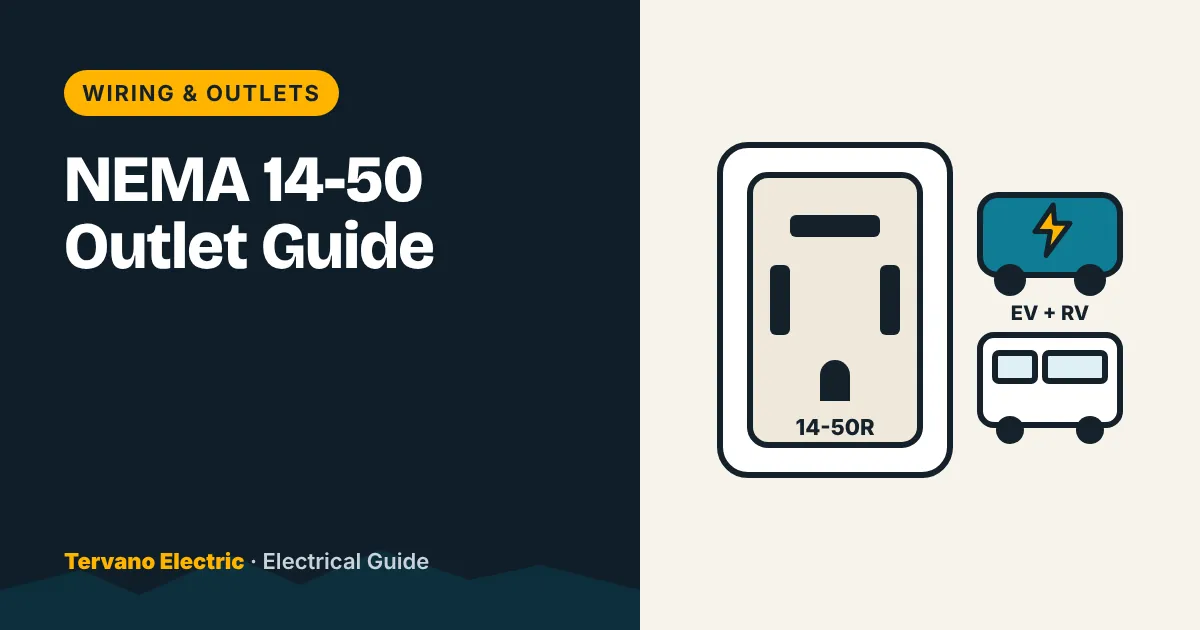
A NEMA 14-50 outlet is a 50 amp, 125/250 volt receptacle with four connections: two hot wires, a neutral and a ground. It is the standard 50 amp outlet for RV hookups and a common choice for Level 2 EV charging. A typical home install uses a 50 amp two-pole breaker and 6 AWG copper wire, with GFCI protection in garages and outdoors.
Safety first. A 50 amp, 240 volt circuit can kill. Installing one means working inside your main panel. Hire a licensed electrician and pull a permit. Never plug an RV or EV into an outlet with loose or scorched contacts.
You just bought an electric car, or you want to plug your RV in at home before a trip. The salesperson says, "Just get a 14-50 put in." Then the questions start. What wire? What breaker? Does it need GFCI? Is it the same as a dryer outlet? This guide answers all of it.
We cover what this outlet is, how it is wired, how it compares to other 50 amp outlets and what installation involves. Want it installed for you? Our EV charger installation service page explains how a licensed electrician handles the job.
What is a NEMA 14-50 outlet?
A NEMA 14-50 is a 50 amp receptacle that supplies both 120 volts and 240 volts. NEMA stands for the National Electrical Manufacturers Association, which sets the plug and outlet shapes used in North America.
How to read the name
- 14 means a four-wire configuration with two hots, a neutral and a ground, rated 125/250 volts.
- 50 means it is rated for 50 amps.
- 14-50R is the receptacle (outlet). 14-50P is the plug.
What it looks like
It has two vertical slots for the hot wires and a wider slot for the neutral. A round or U-shaped slot is the ground. It is larger than a standard dryer outlet.
How is a NEMA 14-50 outlet wired?
A 14-50 uses four conductors. The two hots connect to the brass terminals, the neutral to the silver terminal and the ground to the green terminal.
| Terminal | Wire | Typical color | Purpose |
|---|---|---|---|
| X (brass) | Hot leg 1 | Black | 120 volts to neutral, 240 volts to the other hot |
| Y (brass) | Hot leg 2 | Red | 120 volts to neutral, 240 volts to the other hot |
| W (silver) | Neutral | White | Return path for 120 volt loads |
| G (green) | Equipment ground | Bare or green | Safety path for faults |
This is the basic NEMA 14-50 wiring diagram. RVs use the neutral because they run 120 volt circuits from both legs. Most EV chargers only use the two hots and ground, but the outlet is still wired with all four.
50 amp RV outlet wiring
A 50 amp RV plug wiring setup is the same 14-50 layout. The RV splits the two 120 volt legs between its circuits. That gives it far more power than a 30 amp RV plug. Never wire an RV outlet with two hots and no neutral.
What wire and breaker size does a 14-50 outlet need?
A 50 amp 14-50 circuit usually needs 6 AWG copper NM-B cable, or 8 AWG copper THHN in conduit with 75°C terminals. It uses a 50 amp two-pole breaker. Long runs may need larger wire.
| Item | Typical choice | Notes |
|---|---|---|
| Breaker | 50 amp, 2-pole | GFCI type where required |
| Copper NM-B cable (Romex) | 6/3 with ground | Uses the 60°C ampacity column |
| Copper THHN in conduit | 8 AWG, with 10 AWG ground | 75°C terminals required |
| Aluminum | 6 AWG or larger | Terminals must be rated AL/CU |
| Long runs over about 100 feet | Size up one gauge | To limit voltage drop |
How we built this table: sizes follow NEC Table 310.16 ampacity for a 50 amp circuit and common residential practice. Your electrician confirms the final size from distance, cable type and local code. See our full wire size and amp chart for every circuit size.
Can a 14-50 outlet be on a 40 amp breaker?
Yes. The NEC allows a 50 amp receptacle on a 40 amp circuit. Some EV owners do this when panel space or capacity is tight. The charger must then be set to 32 amps or less.
Can you use a NEMA 14-50 for EV charging?
Yes. A 14-50 outlet with a portable Level 2 charger is one of the most common home EV setups. Charging is a continuous load. So the charger can draw at most 80 percent of the circuit, or 40 amps on a 50 amp circuit.
- Many portable chargers, including Tesla Mobile Connector models, draw about 32 amps on a 14-50.
- At 32 amps and 240 volts, that is about 7.7 kW. For many EVs, that adds very roughly 20 to 30 miles of range per hour.
- Use a heavy-duty, industrial-grade receptacle. Cheap outlets can overheat under hours of continuous load.
- Plug in and leave it. Frequent plugging wears the contacts.
The U.S. Department of Energy explains Level 1 and Level 2 charging in its home charging guide. Check for utility incentives too, as in our EV charger rebate guide.
14-50 outlet vs hardwired EV charger
For a full comparison of charger speeds and costs, see our Level 2 EV charger guide. A hardwired wall charger can run at up to 48 amps on a 60 amp circuit and avoids receptacle wear. A 14-50 outlet costs less and lets you unplug and take the charger with you, or use it for an RV too. For daily charging of most EVs, either works.
NEMA 14-50 vs 6-50 vs 14-30 vs TT-30: which outlet do you need?
A 14-50 has a neutral and supplies 120 and 240 volts. A 6-50 is 240 volts only, with no neutral. A 14-30 is a 30 amp dryer outlet. A TT-30 is a 30 amp, 120 volt RV outlet.
| Outlet | Amps | Volts | Wires | Common use | EV charging max (80%) |
|---|---|---|---|---|---|
| NEMA 14-50 | 50 | 120/240 | 2 hots, neutral, ground | RVs, EVs, ranges | 40 A |
| NEMA 6-50 | 50 | 240 | 2 hots, ground | Welders, some EV chargers | 40 A |
| NEMA 14-30 | 30 | 120/240 | 2 hots, neutral, ground | Electric dryers | 24 A |
| NEMA 10-30 | 30 | 120/240 | 2 hots, neutral (no ground) | Older dryers | Not recommended |
| TT-30 | 30 | 120 | Hot, neutral, ground | 30 amp RVs | 24 A at 120 V |
| NEMA 5-20 | 20 | 120 | Hot, neutral, ground | Kitchen and garage outlets | 16 A at 120 V (Level 1) |
How we compared them: each outlet is listed by its NEMA rating, voltage, conductors and typical use. The EV column applies the 80 percent continuous-load rule. Plugs only fit matching outlets, so never force or modify a plug.
NEMA 14-50 vs 6-50
Choose a 14-50 if you want RV compatibility or the widest choice of EV charger plugs. Choose a 6-50 if you only need 240 volts, such as for a welder or a charger with a 6-50 plug. Both use a 50 amp two-pole breaker.
Does a NEMA 14-50 outlet need GFCI protection?
Usually yes. Newer code editions require GFCI protection for 240 volt receptacles in garages, outdoors and other listed places. Outlets installed for EV charging need it too. That normally means a 50 amp two-pole GFCI breaker.
Some EV chargers have their own ground fault protection, which can sometimes cause nuisance trips with a GFCI breaker. A qualified electrician picks compatible equipment. Learn how ground fault protection works in our GFCI outlet guide, and why breakers trip in breaker keeps tripping.
How is a NEMA 14-50 outlet installed?
A licensed electrician confirms panel capacity, runs the circuit, installs the breaker and receptacle, then tests it. Most jobs take a few hours.
- Load calculation. Confirm the panel and service can carry another 50 amps. See our panel size guide.
- Permit. Pull the electrical permit. See how electrical permits work.
- Run the cable or conduit from the panel to the outlet location.
- Install the breaker, GFCI type where required.
- Mount the receptacle in a box sized for it, at a height that suits the charger or RV cord.
- Torque the terminals to the maker specification. Loose screws cause heat and melting.
- Test and inspect. Check voltage on each leg, then pass inspection.
If the panel is full or undersized, you may need a panel upgrade or a subpanel. Outlets in a detached shop need a feeder, covered on our shop and garage electrical page.
How much does it cost to install a 14-50 outlet?
A short run next to the panel may cost a few hundred dollars. Long runs, trenching or panel work can push it past a thousand. A written estimate is the only reliable number.
Need a 14-50 outlet installed?
In Twin Falls or the Magic Valley? Tervano Electric installs NEMA 14-50 outlets and hardwired chargers for EVs and RVs, with permits. Request an estimate or call (208) 719-5016.
What NEMA 14-50 mistakes should you avoid?
- Using 8 AWG Romex on a 50 amp breaker. NM-B needs 6 AWG for 50 amps.
- Skipping GFCI where code requires it.
- Using a cheap receptacle for EV charging. Choose an industrial-grade model.
- Leaving terminals loose. Torque them to spec.
- Wiring an RV outlet without a neutral. It can damage RV electronics.
- Plugging an EV charger into a dryer outlet with an adapter. Adapters can overheat and void warranties.
- Doing it without a permit. Use a licensed electrician.
Need other outlets added at the same time? See our outlet installation service.
NEMA 14-50 outlet: frequently asked questions
What is a NEMA 14-50 outlet used for?
A NEMA 14-50 outlet powers RVs, Level 2 EV chargers, electric ranges and some shop equipment. It supplies 50 amps at both 120 and 240 volts through four wires.
What size wire do I need for a 14-50 outlet?
Most installs use 6 AWG copper NM-B cable, or 8 AWG copper THHN in conduit with 75°C terminals, on a 50 amp breaker. Long runs may need a larger size.
What is the difference between a NEMA 14-50 and 6-50?
A 14-50 has four wires including a neutral and supplies 120 and 240 volts. A 6-50 has three wires with no neutral and supplies 240 volts only.
Does a NEMA 14-50 need a GFCI breaker?
In most garages, outdoor locations and EV charging installs, yes. Newer NEC editions require GFCI protection for these 240 volt receptacles. Check your local code edition.
How fast does a 14-50 outlet charge an EV?
With a 32 amp portable charger, a 14-50 delivers about 7.7 kW. That adds very roughly 20 to 30 miles of range per hour for many EVs, depending on the car.
Can I plug my RV into a 14-50 outlet at home?
Yes, if the RV has a 50 amp plug and the outlet is wired correctly with two hots, a neutral and a ground. A 30 amp RV needs an adapter to a 14-50.
Can I install a 14-50 outlet myself?
It is not recommended. It requires work inside the main panel, a permit and inspection in most areas. Mistakes can cause fires or shock.
Is a NEMA 14-50 outlet right for you?
A 14-50 outlet is the most flexible 50 amp outlet you can add to a home. It charges most EVs overnight and powers a 50 amp RV. Back to that salesperson's advice to just get a 14-50. Now you know it means a 50 amp breaker, 6 AWG copper, the right GFCI protection and a quality receptacle.
Here is the order to follow:
- Decide the use. EV only, RV only, or both.
- Check your panel. Make sure there is room and capacity.
- Choose the outlet. 14-50 for flexibility, 6-50 for 240 volt only.
- Hire a licensed electrician and get the permit.
Are you charging an EV or powering an RV from a 14-50 today? Share your setup in the comments. In Twin Falls or the Magic Valley, contact Tervano Electric for an install.
Would you choose a 14-50 outlet or a hardwired charger for your garage?
Sources: NFPA 70: National Electrical Code · U.S. DOE: charging an EV at home · National Electrical Manufacturers Association (NEMA).
Need an Electrician in Twin Falls?
Licensed, insured, permitted. Written estimate before work starts.
📞 (208) 719-5016Get an Estimate