
Whole House Surge Protector: How It Works, Which Type You Need and Is It Worth It
A surge protector at your electrical panel guards every circuit in the house at once. Here is how it works, which type to choose and what the code now requires.
 By Clement James, Tervano Electric · Twin Falls, Idaho · November 2026
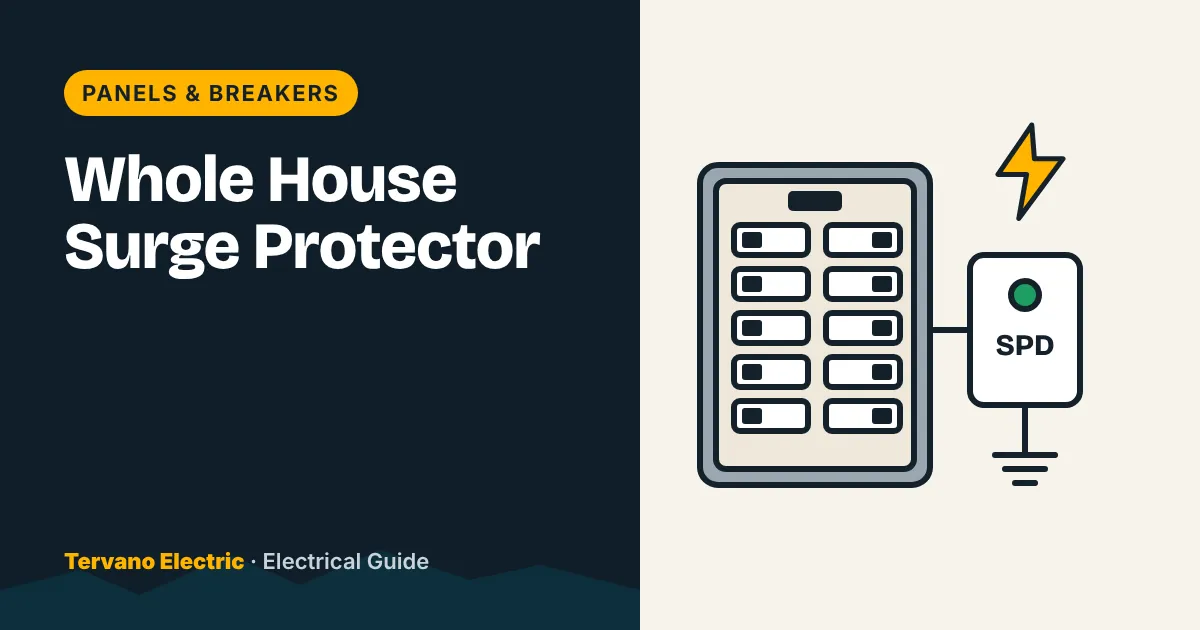
A whole house surge protector is a surge protective device (SPD) installed at your electrical panel or meter. When voltage spikes, it sends the extra energy to ground before it reaches your circuits. It protects every hardwired appliance at once, like the furnace, AC, range and water heater. It works best paired with plug-in surge strips at sensitive electronics.
Safety first. A panel-mounted surge protector connects directly to the live bus inside your breaker box. Installing one means removing the inner cover, where parts stay energized even with the main breaker off. This is a job for a licensed electrician.
A summer storm rolls through. The lights blink twice and come back. Everything seems fine until the next morning, when the furnace control board will not start, the garage door opener is dead and the microwave clock is blank. Nothing was hit by lightning, yet three appliances are damaged.
That is what a power surge can do. In this guide we explain how panel surge protection works, the difference between Type 1, 2 and 3 devices, what the electrical code requires, what it costs and how to tell when one needs replacing. To see what a professional install involves, visit our whole-home surge protection service page.
What is a whole house surge protector?
It is a device mounted at the service panel or meter that limits voltage spikes on every circuit in the home. The technical name is surge protective device, or SPD. Inside are metal oxide varistors (MOVs) that conduct only when voltage climbs too high.
Under normal voltage the device does nothing. During a spike, the MOVs turn on in billionths of a second and shunt the surge to the grounding system. When voltage returns to normal, they turn off again. A plug-in strip does the same thing for one outlet. A panel device does it for the whole house.
Where do power surges come from?
- Lightning striking power lines nearby, even miles away.
- Utility switching and grid faults that bounce voltage on the lines.
- Large motors cycling inside the home, like AC compressors, well pumps and refrigerators.
- Generators starting, stopping or transferring load.
Many surges are small and start inside the home. They do not destroy anything at once, but they wear down electronics over time. If your lights dim when a motor starts, read why your lights flicker.
How does a whole house surge protector work?
It clamps voltage. When a spike arrives, the SPD diverts the excess current to the ground and neutral, keeping the voltage on your circuits near a safe level. The rest of the surge energy is absorbed and released as a tiny amount of heat.
- A spike enters the service from the utility lines or starts inside the home.
- The voltage rises above the SPD clamping level.
- The MOVs conduct and send the excess current to the grounding system.
- Voltage on your circuits stays near normal.
- The MOVs reset when the spike passes, and the status light stays green.
A surge protector only works as well as its ground. A loose ground rod, a missing bonding jumper or a long, looping SPD lead all reduce protection. That is why location and short leads matter so much.
Type 1 vs Type 2 vs Type 3 surge protector: what is the difference?
SPDs are grouped by where they are installed. Type 1 goes on the line side of the main breaker. Type 2 goes on the load side, usually in the panel. Type 3 is a plug-in or point-of-use device.
| Type | Where it goes | What it protects | Typical use |
|---|---|---|---|
| Type 1 | Between the utility and the main breaker, often at the meter | The whole service, including the main panel | Homes with frequent lightning, farms, detached services |
| Type 2 | In or next to the main panel, on a breaker | Every branch circuit fed by that panel | Most homes, the most common whole house choice |
| Type 3 | At the outlet, at least 30 feet of wire from the panel | Plugged-in devices only | TVs, computers, routers, gaming systems |
How we built this table: it follows the UL 1449 SPD type definitions and the NEC placement rules. Many modern units are listed as both Type 1 and Type 2, so they can go in either location.
Do you need more than one type?
For the best results, use layers. A Type 1 or Type 2 device at the panel takes the big hit. Type 3 strips at sensitive electronics catch the smaller spikes that remain. A detached shop or barn with its own panel should have its own SPD too.
Is surge protection required by the electrical code?
Yes, for many homes. Starting with the 2020 National Electrical Code, section 230.67 requires a Type 1 or Type 2 SPD on every service supplying a dwelling unit. The rule also applies when service equipment is replaced.
- New homes: an SPD is required on the service.
- Panel or service replacement: the replaced service must have an SPD.
- 2023 NEC: keeps the rule and requires SPDs rated at least 10 kA nominal discharge current.
- Location: the SPD must be part of the service equipment or right next to it.
Your state or city decides which NEC edition applies, so check with the local inspector. Idaho uses the 2023 NEC. Our guide to NEC 2023 changes covers this and the other rules that affect homeowners. If you are replacing a panel anyway, plan the SPD into the job. See our panel replacement service for what that involves.
Is a whole house surge protector worth it?
For most homes, yes. One device protects appliances worth thousands of dollars, and it costs far less than a single furnace board or AC control. Modern appliances are full of circuit boards that are sensitive to spikes.
| Item | Why it matters in a surge |
|---|---|
| Furnace and AC | Control boards and blower motors are costly to replace |
| Range, washer, dryer | Electronic controls are hardwired or on dedicated circuits |
| Well pump controls | Pressure switches and VFDs sit on long, exposed lines. See why a well pump stops working |
| Garage door opener | Logic boards fail often after storms |
| EV charger | An expensive device on a 240 volt circuit. See our Level 2 EV charger guide |
| Smoke and CO alarms | Hardwired units can fail without warning |
How we built this table: it lists common hardwired loads that plug-in strips cannot protect. Real-world damage depends on the surge, the grounding and the appliance.
What panel surge protection cannot do
It will not stop a direct lightning strike to the house. It does not protect lines that bypass the panel, like cable TV, satellite or phone lines, unless those get their own protection. It also does not replace plug-in strips for sensitive electronics.
How do you choose the right SPD for your panel?
Pick a UL 1449 listed device made for your panel, with a 10 kA or higher nominal discharge rating and a visible status light. Your electrician will match it to the panel brand and service size.
- Check the listing. Look for UL 1449 and a Type 1 or Type 2 rating.
- Check the In rating. At least 10 kA nominal discharge current meets the 2023 NEC.
- Check the VPR. A lower voltage protection rating means less voltage gets through.
- Choose the mounting. Breaker-style units plug into the panel. External units mount beside it.
- Look for indicators. Status lights or an alarm show when protection is gone.
- Read the warranty. Some include connected equipment coverage. Read the terms closely.
Not sure what is in your panel? Our breaker box guide explains the parts and how to read the label inside the door.
How is a panel surge protector installed?
An electrician mounts the SPD at the panel, connects it to a dedicated double pole breaker or the line side, and bonds it to ground with the shortest leads possible. Most jobs take one to three hours.
- Shut off the main breaker and verify the panel is de-energized where possible.
- Choose a location close to the breaker it will use, with short, straight leads.
- Install the breaker or line side connection the manufacturer specifies.
- Connect the neutral and ground conductors.
- Restore power and confirm the status lights show protected.
- Have the work inspected where a permit is required.
Many jurisdictions need a permit for panel work. If the panel is full, old or a problem brand, the install can be combined with an upgrade.
How much does whole home surge protection cost?
The device itself usually costs less than the labor. Pricing varies with the panel, the SPD type, local labor rates and permit fees. In our Twin Falls market, a Type 2 SPD at the main panel typically runs about $350 to $650 installed. Get a written estimate for your home.
How long does a panel surge protector last?
There is no fixed lifespan. The MOVs wear down a little with every surge they absorb. A unit in a quiet area may last many years, while one that takes repeated hits can be used up in one storm season.
- Check the status light a few times a year and after big storms.
- Replace the unit when the light goes out or turns red, or the alarm sounds.
- Have it checked after a nearby lightning strike or a utility fault.
Do you need surge protection with a generator?
It is a good idea. Generators can create voltage swings when they start, stop and pick up large loads. An SPD at the panel protects the house during both utility and generator power. Planning a standby unit? Start with whole house generator cost. Learn how backup power connects in our generator transfer switch guide.
What mistakes should you avoid?
- Installing it yourself. The work happens inside a live panel.
- Long, coiled leads. Every extra inch of wire lets more voltage through.
- Ignoring grounding. A poor ground makes the SPD far less effective.
- Skipping plug-in strips. Sensitive electronics still need point-of-use protection.
- Never checking the light. A spent unit looks the same as a working one from across the room.
- Forgetting other panels. Detached shops and barns need their own protection.
Want surge protection for your home?
In Twin Falls or the Magic Valley? Tervano Electric installs and checks whole-home surge protection. Request an estimate or call (208) 719-5016.
Whole house surge protector: frequently asked questions
What is a whole house surge protector?
It is a surge protective device installed at the electrical panel or meter. It limits voltage spikes on every circuit in the home by sending excess energy to ground.
How does a whole house surge protector work?
It uses metal oxide varistors that conduct only when voltage climbs too high. During a spike they divert the extra current to ground, then reset when voltage returns to normal.
Is a whole house surge protector worth it?
For most homes, yes. One device protects hardwired appliances like the furnace, AC, range and water heater, which plug-in strips cannot protect.
What is the difference between a Type 1 and Type 2 surge protector?
A Type 1 SPD installs on the line side of the main breaker, often at the meter. A Type 2 installs on the load side, in or next to the panel. Many units are listed as both.
Is surge protection required by code for homes?
Since the 2020 NEC, section 230.67 requires a Type 1 or Type 2 SPD on services supplying dwelling units, including when service equipment is replaced. Your local code edition decides how it applies.
How long does a whole house surge protector last?
It depends on how many surges it absorbs. Check the status light regularly and replace the unit when the light goes out or after a major surge.
Can I install a panel surge protector myself?
It is not recommended. The device connects inside a live panel, and many areas require a permit. A licensed electrician should install it.
What should you do next?
Surges are not rare events. They happen every day, from small spikes when motors cycle to big ones during storms and utility faults. A surge protector at the panel is one of the simplest upgrades you can make to protect the expensive equipment you cannot plug into a strip. Remember the storm that took out a furnace board, a garage door opener and a microwave? A properly grounded panel SPD could have stopped much of that damage.
Here is the order to follow:
- Check your panel for an existing SPD and its status light.
- Add a Type 2 or Type 1 device if you have none, using a licensed electrician.
- Plan the SPD into any panel replacement, since the code requires it.
- Add Type 3 strips for TVs, computers and networking gear.
- Protect detached buildings with their own panels.
Have you lost an appliance to a power surge? Tell us what happened in the comments. In Twin Falls or the Magic Valley, contact Tervano Electric for help.
Which appliance in your home would be hardest to replace after a surge?
Sources: NFPA 70: National Electrical Code · Electrical Safety Foundation International · Electrical Contractor Magazine: residential SPD requirements.
Need an Electrician in Twin Falls?
Licensed, insured, permitted. Written estimate before work starts.
📞 (208) 719-5016Get an Estimate