
Generator Transfer Switch Explained: Automatic vs Manual vs Interlock Kit
A transfer switch is what makes a generator safe to connect to your home. Here is how each type works, what it costs and how to choose the right one.
 By Clement James, Tervano Electric · Twin Falls, Idaho · November 2026
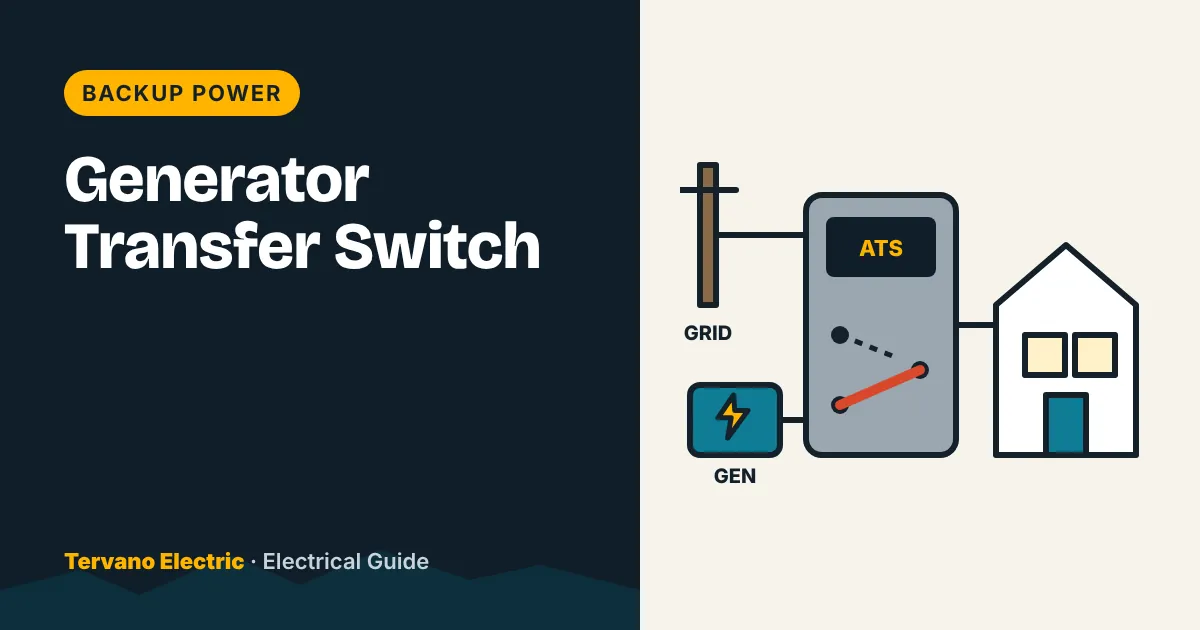
A generator transfer switch safely connects a generator to your home's wiring while disconnecting it from the utility. It stops back-feed, which can electrocute line workers, and lets you power your circuits without extension cords. Standby generators use an automatic transfer switch. Portable generators use a manual transfer switch or a listed interlock kit.
Safety first. Never plug a generator into a wall outlet or dryer receptacle to power your home. This back-feeds the utility lines and can kill workers and neighbors. It is illegal in most places and can start fires.
The power is out and your portable generator is humming in the driveway. Extension cords snake through a cracked window to the fridge and a space heater. The furnace, the well pump and the lights stay dark. A transfer switch fixes all of that safely, and it is often cheaper than people expect.
This guide explains how a transfer switch works, compares every type, covers costs and sizing, and shows what installation involves. If you want a professional to handle it, our generator installation service page explains what is included.
What is a generator transfer switch?
It is a device that switches your home's circuits between utility power and generator power. It can only connect one source at a time, so the generator never feeds power back onto the grid.
Generators can cause voltage swings, so pair yours with surge protection at the panel.
The National Electrical Code requires approved transfer equipment for any generator connected to a building's wiring. That rule lives in Article 702 for optional standby systems.
Why back-feeding is so dangerous
A generator plugged into an outlet sends power backward through your panel and out to the utility transformer. The transformer steps that voltage up to thousands of volts on the street lines. Line workers who think the line is dead can be electrocuted. The U.S. Consumer Product Safety Commission warns against this practice.
How does a generator transfer switch work?
A transfer switch has two power inputs and one output. A mechanical or electrical mechanism makes sure only one input connects to your circuits at a time.
- Utility power fails. Your home goes dark.
- The switch disconnects the utility. This is the step that prevents back-feed.
- The generator connects. Power flows from the generator to the selected circuits.
- Utility power returns. The switch disconnects the generator and reconnects the utility.
With an automatic transfer switch, all four steps happen on their own, usually within seconds. With a manual switch or interlock, you flip the switches yourself.
What are the types of generator transfer switches?
There are four common ways to connect a generator safely. The right one depends on your generator type, your budget and how many circuits you need.
1. Automatic transfer switch (ATS)
An automatic transfer switch senses an outage, starts the standby generator and transfers the load without you lifting a finger. It is the standard choice for whole house generators. A service-rated ATS can sit between the meter and the panel and control the whole home.
2. Manual transfer switch
A manual transfer switch is a small pre-wired panel mounted next to your main panel. It controls a set number of circuits, often 6 to 10. You plug the generator into an outdoor inlet box and flip each circuit from LINE to GEN.
3. Generator interlock kit
An interlock kit is a sliding metal plate installed on your main panel. It physically prevents the main breaker and a generator breaker from being on at the same time. It lets a portable generator power any circuit in the panel. The kit must be listed for your exact panel model.
4. Meter-mounted transfer device
Some utilities allow a meter collar device that installs behind the electric meter. It switches between utility and generator at the meter. It requires approval from your utility, and many utilities do not allow it.
Automatic vs manual vs interlock: which transfer switch is best?
An automatic transfer switch is best for standby generators. An interlock kit is the best value for portable generators. A manual transfer switch suits homes that want simple, labeled circuit control.
| Option | Works with | Circuits powered | Operation | Typical installed cost | Best for |
|---|---|---|---|---|---|
| Automatic transfer switch (whole house) | Standby generator | Whole home | Fully automatic | $1,500 to $3,500 (with generator install) | Whole house standby systems |
| Automatic transfer switch (load-managed) | Standby generator | Whole home, sheds big loads | Fully automatic | $1,500 to $4,000 | Smaller generator, large home |
| Manual transfer switch | Portable generator | 6 to 10 chosen circuits | Flip each circuit | $600 to $1,500 | Simple portable setups |
| Generator interlock kit | Portable generator | Any panel circuit, within generator capacity | Flip main and generator breaker | $500 to $1,200 with inlet box | Best value for portables |
| Meter collar device | Portable generator | Whole panel, within capacity | Plug in at the meter | Varies, utility approval needed | Where the utility allows it |
| Extension cords only | Portable generator | Plug-in appliances only | Manual | Cords only | Short outages, no hardwired loads |
| Back-feed cord (suicide cord) | None | Not allowed | Illegal and deadly | Never | Never |
How we compared them: each option is rated on the generator it works with, how many circuits it powers, how you operate it and typical installed cost from our projects and published guides. Costs vary by panel, distance and permit fees.
Is a generator interlock kit as safe as a transfer switch?
Yes, when it is listed for your panel and installed correctly. A listed interlock kit meets the code requirement for transfer equipment because it mechanically prevents both sources from connecting at once.
- The kit must match your panel brand and model, such as Square D, Eaton, Siemens or GE.
- The generator breaker must be secured with a hold-down kit.
- An outdoor power inlet box and the right cord are required.
- A permit and inspection are usually required.
- You must manage loads so the generator does not overload.
An interlock does not work on every panel. Older or full panels may need a panel upgrade first.
What size transfer switch do you need?
Match the transfer switch to your generator output and your service. Whole house automatic switches usually match the service size, such as 100 or 200 amps. Portable setups usually use a 30 or 50 amp inlet.
| Generator size | Common inlet or switch | Typical use |
|---|---|---|
| Up to about 7,500 watts | 30 amp inlet (L14-30) | Furnace, fridge, lights, a few outlets |
| About 7,500 to 12,000 watts | 50 amp inlet | Adds a well pump or more circuits |
| Standby 14 to 26 kW | 100 to 200 amp ATS | Whole home |
| Large standby or farm | 200 to 400 amp ATS | Large homes, farms, shops |
How we built this table: sizes follow common generator outlet ratings and standard ATS sizes. The generator manual and a load calculation set the final choice. Our generator sizing guide covers the math. Well pumps need extra starting power, so read how well pumps behave after outages if you rely on a well.
How much does a generator transfer switch cost?
A manual transfer switch or interlock kit with an inlet box usually costs $500 to $1,500 installed. An automatic transfer switch is part of a standby generator install and adds about $1,500 to $3,500.
- Interlock kit hardware is often under $200. Labor, inlet box, wire and permit make up most of the cost.
- Manual transfer switch kits often run a few hundred dollars before installation.
- Automatic transfer switches cost more because they include sensing, controls and larger contacts.
- Panel upgrades, long wire runs and service-rated equipment add cost.
For full system pricing, see our whole house generator cost guide.
How is a transfer switch installed?
Installation usually takes a few hours for an interlock or manual switch, and one to three days as part of a standby generator install.
- Load review. The electrician picks the circuits or confirms whole-home coverage.
- Permit. The contractor pulls the electrical permit. See how electrical permits work.
- Mount the equipment. The switch, interlock or ATS goes next to the main panel.
- Install the inlet box. Portable setups get a weatherproof inlet outside.
- Wire and label circuits. Every switched circuit is labeled.
- Check the neutral and ground. The generator bonding must match the transfer equipment.
- Inspection and test. The inspector checks the work, then the system is tested under load.
This is licensed electrical work. Hire a licensed electrician for any transfer equipment.
Want your generator connected safely?
In Twin Falls or the Magic Valley? Tervano Electric installs interlock kits, manual transfer switches and automatic transfer switches for homes and farms. Request an estimate or call (208) 719-5016.
How do you use a manual transfer switch or interlock during an outage?
Start the generator outside, connect it to the inlet, then switch your home over one step at a time.
- Place the generator outdoors, at least 20 feet from doors and windows.
- Start the generator and let it warm up.
- Plug the generator cord into the inlet box.
- Turn off the main breaker, or set the switch circuits to OFF.
- Turn on the generator breaker or move circuits to GEN one at a time.
- Add large loads like a well pump or furnace first, then smaller loads.
- When power returns, reverse the steps before turning the main back on.
Our winter power outage checklist covers fuel, cold weather and carbon monoxide safety.
What transfer switch mistakes should you avoid?
- Using a back-feed cord. It is illegal and can kill.
- Installing an unlisted interlock. It must be listed for your panel.
- Overloading the generator. Add loads gradually and watch the total.
- Ignoring the neutral setup. A mismatched neutral can trip GFCIs or create shock risk. Learn more in our GFCI guide.
- Running the generator in a garage. Carbon monoxide kills even with the door open.
- Skipping surge protection. A surge protector helps protect electronics during switching.
Generator transfer switch: frequently asked questions
Do I need a transfer switch for a generator?
Yes, if you connect a generator to your home wiring. The NEC requires approved transfer equipment, such as a transfer switch or listed interlock kit, to prevent back-feed onto utility lines.
What is the difference between an automatic and manual transfer switch?
An automatic transfer switch senses an outage and switches to the generator on its own. A manual transfer switch requires you to start the generator and flip the switches yourself.
Is a generator interlock kit legal?
Yes, in most areas, when the kit is listed for your panel, the generator breaker is secured and the install is permitted and inspected. Check local rules before installing.
How much does it cost to install a transfer switch?
Manual transfer switches and interlock kits usually cost $500 to $1,500 installed. Automatic transfer switches for standby generators usually add $1,500 to $3,500 to the generator install.
What size transfer switch do I need?
Portable generators usually use a 30 or 50 amp inlet and switch. Whole house standby systems use an automatic transfer switch sized to the service, often 100 or 200 amps.
Can I install a generator transfer switch myself?
It is not recommended. Transfer equipment connects to your main panel and needs a permit and inspection in most areas. Mistakes can cause fires or deadly back-feed.
How fast does an automatic transfer switch work?
Most automatic transfer switches start the generator and transfer power within about 10 to 30 seconds after an outage, depending on the settings and generator warm-up time.
Which generator transfer switch should you choose?
A transfer switch is what turns a generator into safe, usable backup power. Standby generators need an automatic transfer switch. Portable generators work best with a listed interlock kit or a manual transfer switch. Back to that driveway generator and the tangle of extension cords. With a transfer switch, the furnace, well pump and lights all come back on safely.
Here is the order to follow:
- Decide portable or standby. That sets the type of switch.
- List the circuits you need. Heat, water, food and lights first.
- Check your panel. It must accept an interlock or ATS, or need an upgrade.
- Hire a licensed electrician and get the permit.
Do you use a portable generator with extension cords today? Share your setup or questions in the comments. In Twin Falls or the Magic Valley, contact Tervano Electric for a safe connection.
Which circuits would you power first in a long outage?
Sources: U.S. CPSC: portable generator safety · Ready.gov: power outages · NFPA 70: National Electrical Code.
Need an Electrician in Twin Falls?
Licensed, insured, permitted. Written estimate before work starts.
📞 (208) 719-5016Get an Estimate