
Level 2 EV Charger Guide: Charging Speed, Cost and How to Pick the Right Home Charger
A Level 2 charger turns overnight charging from a trickle into a full battery. Here is how fast it really is, what it costs and how to choose the right one for your home.
 By Clement James, Tervano Electric · Twin Falls, Idaho · November 2026
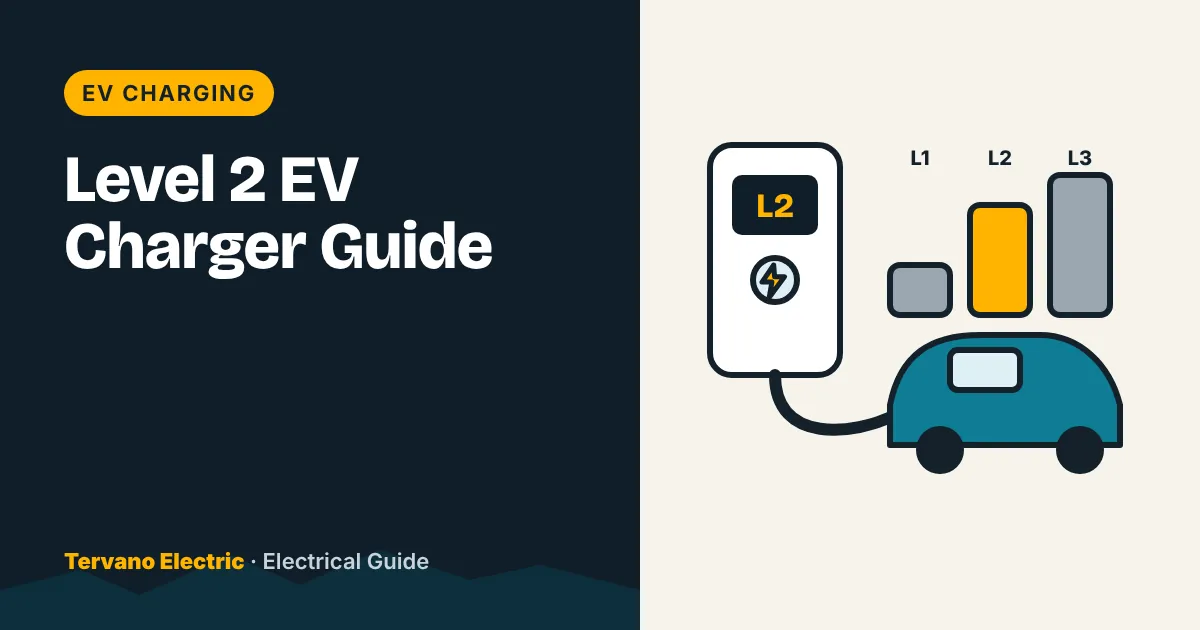
A Level 2 EV charger runs on 240 volts and charges an electric car several times faster than a standard 120 volt outlet. Most home Level 2 chargers deliver 32 to 48 amps, about 7.7 to 11.5 kW, which adds very roughly 20 to 40 miles of range per hour. It needs a dedicated 240 volt circuit, either a NEMA 14-50 outlet or a hardwired connection.
Safety first. A Level 2 charger needs a dedicated 240 volt circuit and work inside your electrical panel. Have a licensed electrician install it with a permit. Never use extension cords or plug adapters to power a Level 2 charger.
Your new EV came with a cord that plugs into a normal outlet. After one night, the battery barely moved. Your neighbor plugs in at 10 p.m. and wakes up to a full charge. The difference is a Level 2 home EV charger, and it is the single best upgrade most EV owners make.
This guide explains what a Level 2 EV charger is, how fast it charges, what it costs and how to choose between models and installation types. When you are ready to install one, our EV charger installation service page shows what a licensed install includes.
What is a Level 2 charger?
A Level 2 charger is electric vehicle supply equipment that uses 208 or 240 volt power. It safely delivers power to your car's built-in charger, which then charges the battery.
The box on the wall is technically called EVSE, short for electric vehicle supply equipment. It talks to the car, checks for faults and only turns on power once the plug is locked in. The actual battery charger lives inside the car, which is why every car has its own maximum Level 2 speed.
Level 1 vs Level 2 vs Level 3 charging: what is the difference?
Level 1 uses a standard 120 volt outlet. Level 2 uses a 240 volt circuit and is the home standard. Level 3, or DC fast charging, is for public stations and road trips.
| Charging level | Power source | Typical power | Range added per hour (approx.) | Where you find it |
|---|---|---|---|---|
| Level 1 | 120 volt household outlet | 1.4 to 1.9 kW | 3 to 5 miles | Any standard outlet |
| Level 2 (home) | 240 volt dedicated circuit | 7.7 to 11.5 kW | 20 to 40 miles | Homes, workplaces |
| Level 2 (public) | 208 or 240 volt | 6 to 19 kW | 20 to 60 miles | Parking garages, hotels, stores |
| Level 3 / DC fast | Commercial 3-phase power | 50 to 350 kW | Often 100+ miles in 20 to 30 minutes | Highway charging stations |
How we built this table: power ranges reflect common equipment ratings, and range per hour is an approximation that varies by vehicle efficiency, battery temperature and the car's onboard charger limit. The U.S. Department of Energy home charging guide explains each level in detail.
Why there is no Level 3 charger for homes
DC fast chargers need large commercial three-phase services and cost tens of thousands of dollars. Homes do not have that kind of power. Level 2 is the fastest practical home option.
How fast is Level 2 charging?
Level 2 charging speed depends on the charger's amps and the car's onboard charger. Most EVs go from nearly empty to full overnight on a 32 to 48 amp Level 2 charger.
| Charger output | Breaker size | Power at 240 V | Range added per hour (approx.) |
|---|---|---|---|
| 16 amps | 20 amp | 3.8 kW | 10 to 15 miles |
| 24 amps | 30 amp | 5.8 kW | 15 to 22 miles |
| 32 amps | 40 amp | 7.7 kW | 20 to 30 miles |
| 40 amps | 50 amp | 9.6 kW | 25 to 35 miles |
| 48 amps | 60 amp | 11.5 kW | 30 to 40 miles |
How we built this table: power equals amps times 240 volts. Range per hour uses a typical efficiency of about 3 to 4 miles per kWh. If your car's onboard charger is limited to 7.7 kW, a 48 amp charger will not charge it any faster than a 32 amp one.
How much does a Level 2 charger cost?
Most home Level 2 chargers cost a few hundred dollars for the unit. Installation in our area typically runs $400 to $1,000, and more for long runs or if your panel needs an upgrade.
| Cost item | Typical range | Notes |
|---|---|---|
| Charger unit | About $300 to $800 | Brand, amps and smart features |
| Standard installation | $400 to $1,000 | Circuit, breaker, outlet or hardwire, permit |
| Long run or outdoor mounting | Add a few hundred dollars | Conduit, trenching, weatherproof parts |
| Panel upgrade if needed | $1,800 to $3,200 | Older or full 100 amp panels |
| Utility rebates | Varies | Check your utility before you buy |
How we built this table: installation and panel ranges match our own published pricing, and unit prices reflect common retail ranges for home chargers. Your quote depends on the distance from the panel and your panel's capacity. See if your utility offers incentives in our EV charger rebate guide.
How do you choose the best Level 2 EV charger for home?
The best home EV charger is the one that fits your car, your panel and your driving. Pick a charger that matches your car's onboard charger, your panel capacity and how far you drive. A 32 to 40 amp charger is enough for most drivers.
- Check your car. Find its maximum AC charging rate in the owner manual.
- Check your daily miles. Most drivers need only 30 to 60 miles a night, which any Level 2 charger covers.
- Check your panel. A load calculation shows whether you have room for a 40, 50 or 60 amp circuit.
- Choose the connector. Most cars use J1772 or NACS (the Tesla-style plug). Adapters exist, but a matching plug is simplest.
- Choose plug-in or hardwired. See the comparison below.
- Pick safety listings. Buy a charger listed by a recognized testing lab, such as UL or ETL.
- Consider smart features. Scheduling helps you charge at off-peak rates.
Plug-in vs hardwired Level 2 charger: which is better?
A plug-in charger uses a NEMA 14-50 or 6-50 outlet and is limited to 40 amps. A hardwired charger connects directly to the circuit and can run up to 48 amps or more.
| Plug-in (NEMA 14-50) | Hardwired | |
|---|---|---|
| Maximum charging current | 40 amps | 48 amps or more |
| Circuit size | 50 amp | Up to 60 amp for 48 amp chargers |
| Portability | Unplug and take it with you | Fixed to the wall |
| Outdoor use | Needs a weatherproof outlet | Better for outdoor installs |
| Wear | Outlet contacts can wear over time | No outlet to wear |
| Also powers an RV | Yes | No |
Learn more about the outlet option in our NEMA 14-50 outlet guide.
What breaker and wire size does a Level 2 charger need?
EV charging is a continuous load, so the circuit must be rated at 125 percent of the charger's current. A 32 amp charger needs a 40 amp circuit, a 40 amp charger needs 50 amps and a 48 amp charger needs 60 amps.
- 40 amp circuit: commonly 8 AWG copper
- 50 amp circuit: commonly 6 AWG copper NM-B, or 8 AWG THHN in conduit with 75°C terminals
- 60 amp circuit: commonly 6 AWG copper THHN in conduit, or 4 AWG copper NM-B
- GFCI: required for EV charging receptacles under newer code editions. See our GFCI guide
- Long runs: size up to limit voltage drop
See the full wire size and amp chart. If the panel cannot carry the new load, you may need a panel upgrade. Our panel size guide explains how to tell.
What if your panel is full?
Options include a smaller charger, a load management device that pauses charging when the house draws heavy power, a subpanel or a panel upgrade. A load calculation shows which makes sense.
How is a Level 2 charger installed?
- Site visit and load calculation.
- Permit. See how electrical permits work.
- Run the circuit from the panel to the garage or driveway.
- Install the breaker, GFCI type where required.
- Mount the charger or outlet near where the car parks.
- Test the charger with your car and set the current limit to match the circuit.
- Final inspection.
Most installs take two to four hours when the panel is close to the garage. A detached garage needs a feeder, covered on our shop and garage electrical page. Always hire a licensed electrician.
Ready for faster home charging?
In Twin Falls or the Magic Valley? Tervano Electric installs Level 2 chargers and 14-50 outlets with permits and load checks. Request an estimate or call (208) 719-5016.
What Level 2 charger mistakes should you avoid?
- Buying more amps than the car can use. It costs more with no speed gain.
- Skipping the load calculation. An overloaded panel trips or overheats. Read why breakers trip.
- Using a dryer outlet adapter. Adapters can overheat and void warranties.
- Using a cheap outlet for a plug-in charger. Choose an industrial-grade receptacle.
- Ignoring the cable length. Make sure the cord reaches your charge port where you park.
- Installing without a permit. It causes insurance and resale problems.
Level 2 EV charger: frequently asked questions
What is a Level 2 charger?
A Level 2 charger is EV supply equipment that uses a 240 volt circuit. It charges much faster than a standard outlet, typically adding 20 to 40 miles of range per hour at home.
What is the difference between Level 1 and Level 2 charging?
Level 1 uses a 120 volt outlet and adds about 3 to 5 miles per hour. Level 2 uses 240 volts and adds about 20 to 40 miles per hour, enough to fully charge most EVs overnight.
How much does a Level 2 charger installation cost?
Installation in our area typically runs $400 to $1,000, plus the charger unit. Long wire runs, outdoor mounting or a panel upgrade can raise the total.
What size breaker do I need for a Level 2 charger?
Use a breaker rated at 125 percent of the charger output. That means 40 amps for a 32 amp charger, 50 amps for 40 amps and 60 amps for 48 amps.
Is a hardwired or plug-in Level 2 charger better?
Hardwired chargers can run faster, up to 48 amps or more, and suit outdoor installs. Plug-in chargers on a 14-50 outlet are limited to 40 amps but are portable and can also power an RV.
Can I install a Level 2 charger at home myself?
It is not recommended. It requires a new 240 volt circuit, work inside the panel and usually a permit and inspection. Hire a licensed electrician.
Is there a Level 3 charger for home?
No. Level 3 DC fast chargers need commercial three-phase power and cost tens of thousands of dollars. Level 2 is the fastest practical home charger.
Should you install a Level 2 EV charger?
For almost every EV owner, a Level 2 EV charger is worth it. It turns overnight charging from a few miles into a full battery, every night, at home. Remember that slow trickle from the standard cord at the start of this guide. With a 32 to 48 amp Level 2 charger on the right circuit, you wake up full every morning.
Here is the order to follow:
- Check your car and your daily miles. They set the charger size you need.
- Get a load calculation. It shows whether your panel can take the new circuit.
- Choose plug-in or hardwired. Plug-in for flexibility, hardwired for speed.
- Hire a licensed electrician and get the permit.
Which EV do you drive, and how are you charging it today? Share your setup in the comments. In Twin Falls or the Magic Valley, contact Tervano Electric for an install.
How many miles do you drive on a typical day?
Sources: U.S. DOE: charging an EV at home · NFPA 70: National Electrical Code (Article 625) · Electrical Safety Foundation International.
Need an Electrician in Twin Falls?
Licensed, insured, permitted. Written estimate before work starts.
📞 (208) 719-5016Get an Estimate