
GFCI Outlet Guide: How It Works, Where You Need One and How to Fix Common Problems
The outlet with the TEST and RESET buttons saves lives every year. Here is how it works, where the code requires it and what to do when it trips.
 By Clement James, Tervano Electric · Twin Falls, Idaho · November 2026
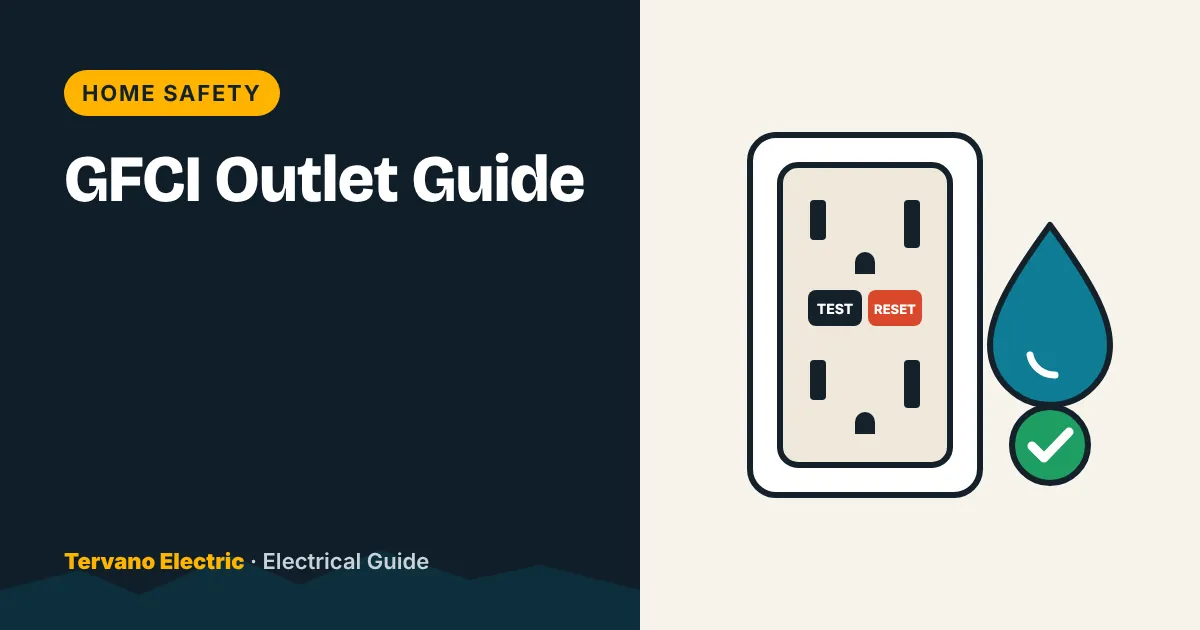
A GFCI outlet is a ground fault circuit interrupter built into a receptacle. It watches the current going out on the hot wire and coming back on the neutral. If about 5 milliamps goes missing, it cuts power in a fraction of a second. That stops a shock before it can stop your heart. Code requires GFCI protection in bathrooms, kitchens, garages, outdoors and other damp areas.
Safety first. Turn off the breaker and confirm the outlet is dead with a tester before you remove a cover or change a receptacle. If an outlet is warm, scorched or buzzing, leave it off and call a licensed electrician.
You plug in a hair dryer and the bathroom goes dark. Or the kitchen outlets quit and nothing you try brings them back. Then you spot a small RESET button on an outlet across the room. That little button is the GFCI, and it is one of the most important safety devices in your home.
This guide explains how a GFCI works, where the National Electrical Code requires one, how to test it and how to fix the most common problems. Need outlets added or upgraded? Our outlet installation service page explains what an electrician handles.
What is a GFCI outlet?
A GFCI outlet is a receptacle that shuts off power when it detects a ground fault. A ground fault is current leaking through an unintended path, such as water or a person, back to ground.
GFCI stands for ground fault circuit interrupter. You may also see GFI, which means the same thing. You can spot one by the TEST and RESET buttons on its face.
GFCI outlet vs regular outlet
A regular outlet only delivers power. A GFCI delivers power and constantly checks for leaks. A standard breaker protects wires from overheating. A GFCI protects people from shock.
GFCI vs AFCI
For the full comparison, see our AFCI breaker guide. A GFCI protects people from shock. An AFCI, or arc fault circuit interrupter, protects homes from fires caused by arcing wires. Many circuits now need both. Dual-function devices provide both in one breaker or outlet.
How does a GFCI work?
A GFCI compares current on the hot and neutral wires many times per second. If the two differ by about 4 to 6 milliamps, it trips. It can open the circuit in as little as one fortieth of a second.
- Balanced current. In a healthy circuit, the same current leaves on the hot wire and returns on the neutral.
- A leak happens. Current finds another path to ground, such as through water or a person.
- The sensor sees the difference. A small coil inside the GFCI detects the imbalance.
- Power shuts off. Internal contacts open and the outlet goes dead until you press RESET.
A tiny current of about 5 milliamps is enough to trip it. Currents a little higher than that can freeze muscles or disturb the heart. That is why the trip point is set so low.
Line and load terminals
A GFCI has LINE terminals for incoming power and LOAD terminals for outlets further down the circuit. Wire to the LOAD side and every outlet downstream is protected too. That is why one GFCI can control several outlets in different rooms. Protected outlets should carry a "GFCI Protected" sticker.
Where are GFCI outlets required?
The National Electrical Code requires GFCI protection wherever water and electricity are likely to meet. The 2023 NEC also expanded the rule from 125 volt outlets to receptacles up to 250 volts in these locations.
| Location (dwelling) | GFCI required? | Notes |
|---|---|---|
| Bathrooms | Yes, all receptacles | Required since the 1970s |
| Kitchens | Yes, all receptacles | 2023 NEC covers every kitchen receptacle, not just countertops |
| Within 6 feet of any sink | Yes | Includes wet bars and utility sinks |
| Garages and accessory buildings | Yes | Includes detached shops and sheds |
| Outdoors | Yes | Weather-resistant receptacles and in-use covers also required |
| Basements | Yes | Finished and unfinished |
| Crawl spaces | Yes | At or below grade |
| Laundry areas | Yes | Including dryer receptacles under the 2023 voltage change |
| Boathouses, pools, hot tubs | Yes | Special rules apply |
How we built this table: it lists the dwelling locations in NEC section 210.8(A) of the 2023 edition, plus pool and hot tub areas from Article 680. Local adoption and amendments vary, so check with your building department. Read our guide to NEC 2023 changes for more on the newest edition.
Other places that need GFCI protection
- Outdoor outlets for HVAC equipment
- Electric vehicle charging outlets
- Hot tubs and spas, covered in our hot tub electrical page
- Garage and shop outlets, covered in our shop and garage electrical page
- Many commercial kitchens, rooftops and wet areas
What are the GFCI rules for bathrooms?
Every receptacle in a dwelling bathroom needs GFCI protection. Bathrooms have extra rules too, because water and electricity meet there more than anywhere else.
- GFCI protection for every bathroom receptacle
- At least one receptacle within 3 feet of the outside edge of each sink basin
- A 20 amp circuit for bathroom receptacles
- No receptacles inside or directly over a tub or shower space
- Exhaust fans and lights over tubs must be rated for damp or wet locations, and some need GFCI protection by the maker instructions
One GFCI at the first outlet can protect the rest of the bathroom outlets on the same circuit. In older homes, a single GFCI in one bathroom sometimes protects outlets in other bathrooms. That is why a bathroom outlet can go dead with no reset button in sight.
How do you test a GFCI?
Press TEST, confirm the power is off, then press RESET. Manufacturers and the Consumer Product Safety Commission recommend testing every GFCI once a month.
- Plug a lamp or night light into the GFCI and turn it on.
- Press the TEST button. The light should go out.
- Press RESET. The light should come back on.
- If the light stays on after TEST, the GFCI is not protecting you. Replace it.
- For a downstream outlet, use a plug-in GFCI tester and press its test button.
Newer GFCIs run a self-test and show a light when they fail. Since 2015, listed GFCIs also refuse to reset if they are wired backward. That is a good safety feature, but it surprises many DIYers.
Why does my GFCI keep tripping?
A GFCI that trips often is usually doing its job. Something on the circuit is leaking current, and you need to find it.
| Cause | What you notice | What to do |
|---|---|---|
| Moisture in an outdoor or bathroom box | Trips after rain or showers | Dry the box, install an in-use cover, seal the box |
| Faulty appliance or cord | Trips when one device runs | Unplug devices one at a time to find it |
| Motors and compressors | Trips at startup of freezers or pumps | Have an electrician check the motor and wiring |
| Too many outlets on the load side | Random trips | Move some outlets to the LINE side or a separate GFCI |
| Shared or crossed neutral | Trips as soon as a load turns on | Needs an electrician to correct the wiring |
| Worn-out GFCI | Trips with nothing plugged in | Replace the GFCI |
| Damaged wiring | Trips constantly, may not reset | Turn it off and call an electrician |
How we built this table: causes are ordered from most to least common in residential service calls, with the symptom that points to each one. If the breaker trips instead of the GFCI, read why a breaker keeps tripping.
Why will my GFCI not reset?
A GFCI will not reset if it has no power, if a fault is still present or if it has reached the end of its life.
- Check for power. A tripped breaker or another GFCI upstream may have cut the power.
- Unplug everything. A faulty device can stop the reset.
- Press RESET firmly. Hold it until it clicks.
- Check other GFCIs. Look in bathrooms, garages, basements and outside.
- Replace the GFCI if it has power, nothing is plugged in and it still will not reset.
If you suspect wiring damage, stop and call an electrician. Our electrical troubleshooting service tracks down hidden faults.
How do you install or replace a GFCI outlet?
Replacing a GFCI is a common job, but the wiring must go to the right terminals. If you are not sure which wires are LINE, hire a licensed electrician.
- Turn off the breaker and verify the outlet is dead with a tester.
- Remove the old outlet and note which wires bring power in.
- Connect incoming power to LINE. Hot to the brass screw, neutral to the silver screw.
- Connect downstream wires to LOAD if you want those outlets protected.
- Connect the ground wire to the green screw.
- Fold the wires and mount the outlet. GFCIs are bulky, so use a deep enough box.
- Turn the power on and test. Press TEST and RESET, then label protected outlets.
Can you install a GFCI without a ground wire?
Yes. The NEC allows a GFCI to replace a two-prong outlet on a circuit with no ground wire. It must be marked "No Equipment Ground." This adds shock protection, but it does not create a ground. Homes with old wiring should read our guide to knob and tube wiring.
GFCI outlet vs GFCI breaker
A GFCI breaker protects a whole circuit from the panel. A GFCI protects itself and the outlets after it. Breakers are handy for hard-to-reach outlets. Outlets are easier to reset where you use them.
Want your outlets brought up to code?
In Twin Falls or the Magic Valley? Tervano Electric installs and upgrades GFCI protection in kitchens, bathrooms, garages and outdoor areas. Request an estimate or call (208) 719-5016.
What GFCI mistakes should you avoid?
- Swapping LINE and LOAD. Newer GFCIs will not reset, and older ones may not protect you.
- Never testing. A GFCI can fail without any sign.
- Putting a refrigerator or freezer on an old, worn GFCI. A failing GFCI can trip and spoil food. Replace worn devices.
- Using a GFCI as a fix for bad wiring. It adds protection, not repairs.
- Forgetting the label. Downstream outlets should show they are GFCI protected.
Home inspectors flag missing GFCI protection more than almost anything else. See our list of electrical problems found in home inspections and our tips for electrical fire prevention.
GFCI outlet: frequently asked questions
What does GFCI stand for?
GFCI stands for ground fault circuit interrupter. It is a device that shuts off power when it detects current leaking to ground, such as through water or a person.
Where are GFCI outlets required?
In homes, the NEC requires GFCI protection in bathrooms, kitchens, garages, outdoors, basements, crawl spaces, laundry areas and within 6 feet of sinks. Local rules may add more.
Do all bathroom outlets need to be GFCI?
Yes. Every receptacle in a dwelling bathroom needs GFCI protection. One GFCI wired on the LOAD side can protect the other outlets on that circuit.
How often should I test a GFCI outlet?
Test every GFCI once a month. Press TEST, make sure power goes off, then press RESET. Replace any GFCI that does not cut the power.
Why does my GFCI outlet keep tripping?
Common causes are moisture, a faulty appliance, a motor starting, too many outlets on the load side or a wiring fault. Unplug devices one at a time to find the cause.
How long does a GFCI outlet last?
Many GFCIs last 10 years or more, but some fail sooner. Monthly testing is the only way to know it still works. Newer models show a light when they fail.
Can a GFCI go bad?
Yes. GFCIs wear out from age, surges and frequent tripping. Replace one that will not trip on TEST, will not reset or trips with nothing plugged in.
What should you do next with your GFCIs?
A GFCI is a small device with a big job. It cuts power in a fraction of a second when current leaks where it should not. Remember that dark bathroom from the start of this guide. Now you know to look for the RESET button, and what it means when it will not reset.
Here is the order to work through:
- Test every GFCI this month. Replace any that fail.
- Check the required locations. Bathrooms, kitchen, garage, outdoors, basement and laundry.
- Label protected outlets. It saves time when something trips.
- Book an electrical inspection for constant tripping, missing protection or old wiring.
Have you chased a GFCI that kept tripping? Share what caused it in the comments. If you are in Twin Falls or the Magic Valley, contact Tervano Electric for help.
When did you last press the TEST button on your outlets?
Sources: U.S. CPSC: GFCI fact sheet · NFPA 70: National Electrical Code · EC&M: NEC requirements for GFCIs and AFCIs.
Need an Electrician in Twin Falls?
Licensed, insured, permitted. Written estimate before work starts.
📞 (208) 719-5016Get an Estimate