
What Is a VFD? How Variable Frequency Drives Work, Save Energy and Protect Your Motors
A VFD lets an AC motor run at exactly the speed the job needs. Here is how it works, where it pays off, and what to get right before you install one.
 By Clement James, Tervano Electric · Twin Falls, Idaho · November 2026
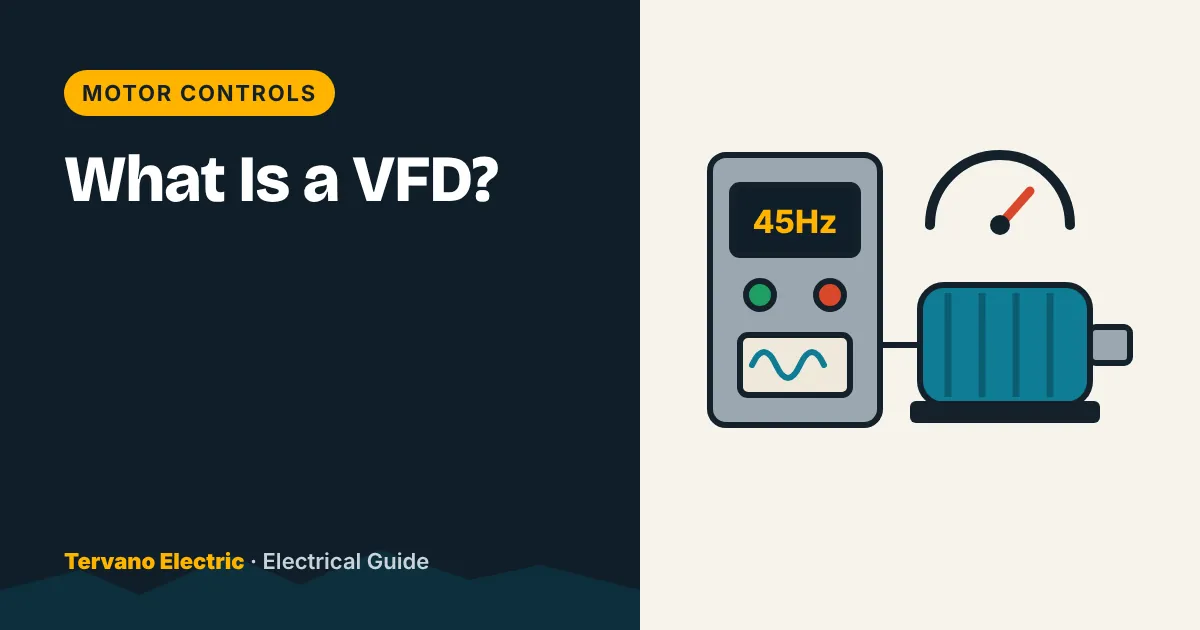
A VFD, or variable frequency drive, is an electronic controller that changes the speed of an AC motor by changing the frequency and voltage of its power. It starts motors smoothly, matches speed to demand and can cut energy use on pumps and fans by a third or more. VFDs are common on irrigation pumps, HVAC fans, well pumps and industrial machines.
Safety first. A VFD stores a dangerous charge in its capacitors for several minutes after power is off. Never open a drive until the DC bus has discharged and you have verified zero voltage. Installation and programming should be done by a qualified electrician.
Imagine a pump that runs flat out all day while a valve throttles half its flow away. It is like driving with one foot on the gas and one on the brake. A variable frequency drive takes the brake off. It slows the motor instead, so you only pay for the work you need.
This guide explains how a VFD works, where it saves money, how it compares to a soft starter and what to watch for when you size and install one. If you run irrigation or well pumps, our VFD and pump motor control service page shows how drives fit into a complete pump panel.
What is a VFD?
A VFD is a motor controller that varies the frequency of the power sent to an AC induction motor. Motor speed follows frequency, so changing the frequency changes the speed.
In North America, utility power runs at 60 hertz. A standard four-pole motor turns at about 1,750 rpm on 60 hertz. Feed it 30 hertz from a drive and it turns at about half that speed. The drive also lowers the voltage in step with the frequency, so the motor keeps its torque without overheating.
Other names for a VFD
- Variable speed drive (VSD)
- Adjustable frequency drive (AFD)
- Adjustable speed drive (ASD)
- AC drive or inverter drive
- Frequency drive or freq drive
All of these describe the same device. Manufacturers such as ABB, Allen-Bradley, Danfoss, Yaskawa and Schneider Electric each use their own name.
How does a variable frequency drive work?
A VFD works in three stages. It turns AC into DC, smooths and stores that DC, then rebuilds AC at whatever frequency the motor needs.
- Rectifier. Diodes convert incoming AC power into pulsing DC.
- DC bus. Large capacitors smooth the DC and store energy for the next stage.
- Inverter. Fast transistors called IGBTs switch the DC on and off thousands of times per second. This pulse-width modulation (PWM) creates a new AC waveform.
- Control board. A processor sets the output frequency from a keypad, a sensor, a timer or a signal from a PLC.
The motor windings smooth the rapid pulses into current that behaves like normal AC. That is why the motor runs quietly and smoothly at any speed the drive selects.
Open loop vs closed loop control
In open loop control, you simply set a speed. In closed loop control, the drive reads a sensor, such as a pressure transducer, and adjusts speed to hold a set point. Constant-pressure well systems and many HVAC systems use closed loop control.
Why use a VFD? The main benefits
The biggest benefits of a variable frequency drive are energy savings, soft starting and better process control.
- Energy savings on pumps and fans that do not need full speed all the time
- Soft starting that cuts inrush current and mechanical shock
- Less water hammer in pipes because flow ramps up and down gently
- Precise control of pressure, flow, speed or temperature
- Longer equipment life for belts, bearings, couplings and pipes
- Built-in motor protection such as electronic overload and phase loss detection
- Three-phase motors on single-phase power with the right drive
How much energy does a VFD save?
On centrifugal pumps and fans, power falls with the cube of speed. This is called the affinity law. In theory, running at 80 percent speed uses about half the power of full speed.
| Motor speed | Flow (approx.) | Power needed (ideal) |
|---|---|---|
| 100% | 100% | 100% |
| 90% | 90% | 73% |
| 80% | 80% | 51% |
| 70% | 70% | 34% |
| 50% | 50% | 13% |
Real savings are lower, because systems have static head, drive losses and motor losses. Still, many pump and fan systems save 20 to 50 percent. Savings are small on loads that already run at full speed most of the time. The Newark guide to saving energy with VFDs explains the affinity laws in more detail.
VFD vs soft starter vs across-the-line starter: which do you need?
Use a VFD when the motor needs to run at different speeds. Use a soft starter when you only need a gentle start and stop. Use an across-the-line starter for simple, full-speed loads.
| Method | Speed control | Starting current | Energy savings | Relative cost | Best for |
|---|---|---|---|---|---|
| Across-the-line starter | None | Very high (6 to 8 times running) | None | Lowest | Small motors, full-speed loads |
| Wye-delta starter | None | Reduced | None | Low | Older large motors |
| Soft starter | Start and stop only | Reduced | None at full speed | Medium | Pumps and conveyors that run at full speed |
| Variable frequency drive | Full range | Lowest | High on variable loads | Higher | Pumps, fans, process control |
| VFD on single-phase supply | Full range | Low | High | Higher (drive is oversized) | Rural sites without three-phase |
| Rotary phase converter | None | High | None | Medium | Shops with mixed three-phase tools |
| Two-speed motor | Two fixed speeds | High | Some | Medium | Fans with simple high and low needs |
| Throttling valve or damper | Flow only, not speed | High | Wastes energy | Low | Legacy systems |
How we compared them: each method is rated on speed control, starting current, energy savings and typical installed cost, relative to the others. Costs vary widely by motor size, so treat the cost column as a ranking, not a price.
Every option still needs short-circuit and overload protection. Our guide to motor circuit protectors and overload relays explains how that protection works.
Where are VFDs used?
VFDs belong on any motor whose load changes over the day. Pumps and fans are the classic examples.
Irrigation and farm pumps
Irrigation pumps often feed systems whose demand changes with zones, pivot position and end guns. A VFD holds steady pressure as demand shifts. See our pages on center pivot electrical systems, grain bin fans and dairy electrical systems.
Well pumps and constant-pressure water
Constant-pressure systems use a VFD and a pressure sensor to keep the same pressure at every tap. If a well system stops working, start with our guide to why a well pump stops working.
HVAC fans, pumps and cooling towers
Commercial buildings use VFDs on air handlers, chilled water pumps and cooling tower fans. They match airflow and water flow to the building load. Our commercial electrical services page covers building systems.
Industrial machines
Conveyors, mixers, compressors and extruders use drives for speed control and soft starts. Learn more on our industrial electrician page.
How do you size a VFD?
Size a VFD by the motor's full-load current, not just horsepower. Then account for the load type, the supply voltage and the operating environment.
- Read the motor nameplate. Note full-load amps, voltage, horsepower and service factor.
- Match the drive current rating. The drive output current must meet or exceed the motor full-load amps.
- Choose the duty rating. Variable-torque loads like pumps and fans use normal duty. Constant-torque loads like conveyors need heavy duty.
- Check the supply. A three-phase motor fed from single-phase power usually needs a much larger drive. Many makers suggest roughly doubling the rating. Check the manual.
- Allow for altitude and heat. Drives lose capacity above about 1,000 meters and in hot enclosures. Apply the maker derating.
- Plan the motor cable length. Long runs to submersible or remote motors may need output filters.
The National Electrical Code requires the supply conductors to be sized at 125 percent of the drive rated input current. The full rules are in Article 430 of NFPA 70, the National Electrical Code.
What should you get right when installing a VFD?
Most VFD problems come from installation, not the drive itself. Get the motor, cable, grounding and cooling right and a drive can run for many years.
Use a motor that suits the drive
PWM pulses stress motor insulation. Inverter-duty motors built to NEMA MG 1 Part 31 handle this best. Older motors may need a filter or replacement.
Watch cable length and reflected waves
Long cables between drive and motor can double the voltage peaks at the motor. Load reactors, dV/dt filters or sine-wave filters protect the windings. Submersible pump makers publish limits for drive use.
Ground and bond carefully
Use the shielded or symmetrical cable the maker recommends. Bond the shield at both ends. Poor grounding causes noise, nuisance trips and bearing damage from stray currents.
Keep it cool and clean
Drives make heat. Size the enclosure, fans and filters for summer temperatures. Dust and moisture shorten drive life, especially in barns and pump houses.
Protect against harmonics and surges
Drives add harmonic distortion to the electrical system. Line reactors reduce it and help protect the drive from surges. A surge protection device adds more protection on rural lines.
Thinking about a VFD for your pump?
On a farm or business in Twin Falls or the Magic Valley? Tervano Electric can size, install and program drives for irrigation, well and process pumps. Request an estimate or call (208) 719-5016.
What are the most common VFD faults?
Most VFD fault codes fall into a few groups. The code tells you where to start looking.
| Fault | What it usually means | Common fixes |
|---|---|---|
| Overcurrent | Motor drew too much current | Lengthen acceleration time, check for jams or shorts |
| Overvoltage | DC bus voltage too high, often during fast stops | Lengthen deceleration, add a braking resistor |
| Undervoltage | Supply dipped or a phase dropped | Check supply voltage, connections and fuses |
| Overtemperature | Drive is too hot | Clean filters, fix fans, improve ventilation |
| Ground fault | Current leaking to ground | Test motor and cable insulation |
| Motor overload | Motor ran above its rating too long | Check the load and the overload setting |
A fault that appears suddenly after years of normal running usually points to a failing motor, cable or fan. Our electrical troubleshooting service tracks these faults down. On farms, the center pivot troubleshooting guide covers related issues.
What VFD mistakes should you avoid?
A few common mistakes cause most early drive and motor failures.
- Sizing by horsepower only. Match the drive current to the motor full-load amps.
- Ignoring single-phase derating. An undersized drive will trip or fail.
- Running a submersible pump too slowly. Pump makers set a minimum speed for motor cooling. Follow it.
- Skipping output filters on long cable runs. Voltage spikes damage motor insulation.
- Putting a drive in a sealed box with no cooling. Heat is the top killer of drives.
- Using a bypass contactor without interlocks. Back-feeding a drive output destroys it.
VFD: frequently asked questions
What does VFD stand for?
VFD stands for variable frequency drive. It is an electronic controller that changes AC motor speed by changing the frequency and voltage of the power supplied to the motor.
What is the main purpose of a VFD?
A VFD controls motor speed to match the load. That saves energy on pumps and fans, starts motors smoothly and gives precise control of flow, pressure or speed.
Does a VFD really save energy?
Yes, on variable loads like centrifugal pumps and fans. Power drops with the cube of speed, so small speed cuts save a lot. Savings are small on loads that run at full speed most of the time.
What is the difference between a VFD and a soft starter?
A soft starter only ramps the motor up and down at start and stop. A VFD controls speed the whole time the motor runs. VFDs cost more but can save energy.
Can a VFD run a three-phase motor on single-phase power?
Yes. Many drives accept single-phase input and output three-phase power. The drive usually needs to be oversized, often about twice the motor rating. Check the drive manual.
Can I put a VFD on any motor?
Most three-phase induction motors can run on a VFD. Inverter-duty motors handle drive voltage spikes best. Older motors, long cables and submersible pumps may need filters or limits.
How long does a VFD last?
Many drives last 10 years or more with clean, cool conditions. Cooling fans and DC bus capacitors are the parts that wear out first.
Is a VFD right for your motor?
A VFD is one of the best upgrades for any motor whose load changes. It saves energy on pumps and fans, starts motors gently and gives you precise control. Remember that pump fighting its own throttling valve from the start of this guide. With a variable frequency drive, the motor simply slows down and the waste disappears.
Use this order to decide:
- Check the load. Pumps and fans with changing demand gain the most.
- Check the motor. Confirm it suits drive use, or plan a filter or replacement.
- Size the drive correctly. Use full-load amps, duty, supply and environment.
- Install it right. Cable, grounding, cooling and protection decide how long it lasts.
Have you added a VFD to a pump or fan? Tell us what changed in the comments. If you are in Twin Falls or the Magic Valley, contact Tervano Electric to talk through your project.
Which motor on your property runs at full speed when it really does not need to?
Sources: NFPA 70: National Electrical Code · Newark: saving energy with VFDs · Tractian: variable frequency drive glossary.
Need an Electrician in Twin Falls?
Licensed, insured, permitted. Written estimate before work starts.
📞 (208) 719-5016Get an Estimate