
What Is a Short Circuit? Meaning, Causes, Warning Signs and How to Find One
A short circuit sends a huge rush of current through a path it was never meant to take. Here is what happens, how it differs from a ground fault, and what to do when you suspect one.
 By Clement James, Tervano Electric · Twin Falls, Idaho · November 2026
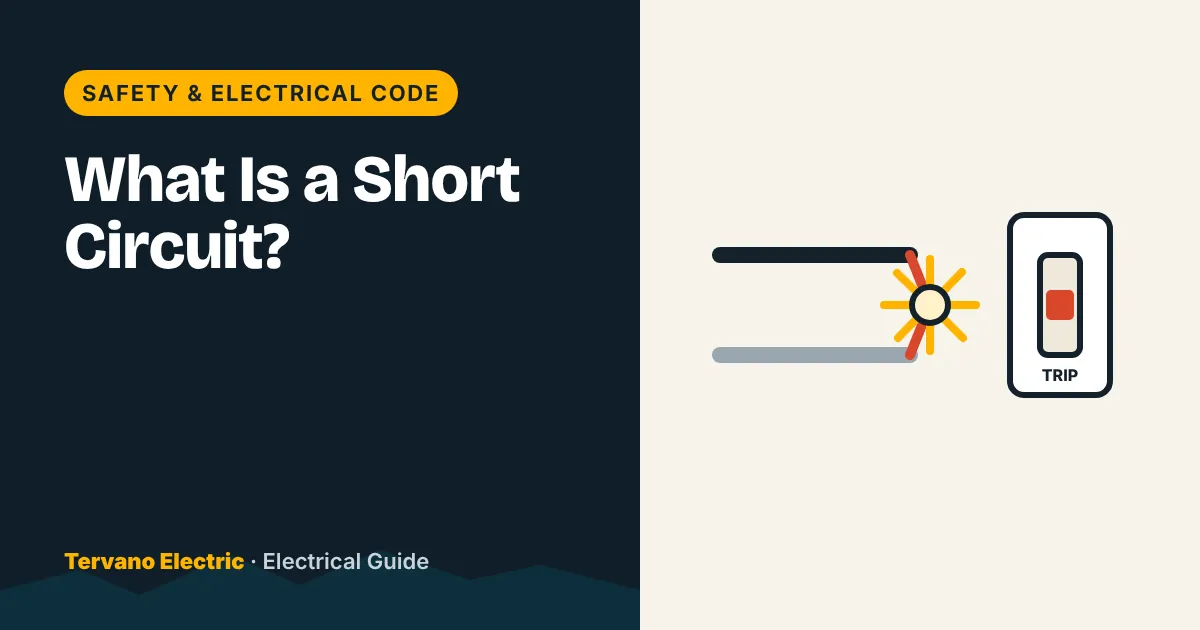
A short circuit is an unintended low-resistance path that lets current bypass the normal load, usually when a hot wire touches a neutral or another hot. With almost no resistance in the way, current jumps to many times the circuit rating in a split second. The breaker should trip instantly. If it does not, wires can overheat, arc and start a fire.
Safety first. If a breaker trips the instant you reset it, leave it off. Do not reset it again and again. A short circuit can melt insulation and start a fire inside a wall. Keep the breaker off and call a licensed electrician.
You plug in a lamp and hear a loud pop. There is a flash at the outlet, the room goes dark and a faint burning smell hangs in the air. At the panel, one breaker has snapped to the middle position. When you push it back on, it trips again before you can let go.
That is the classic sign of a short. This guide explains what a short circuit is, how it differs from a ground fault and an overload, what causes it, how electricians find it and what you can safely do. If you need someone to track one down, see our electrical troubleshooting service.
What is a short circuit?
In a normal circuit, current flows from the hot wire, through a load like a light bulb, and back on the neutral. The load has resistance, which limits how much current flows. A short is a shortcut that skips the load, so there is almost nothing to limit the current.
Why does current spike so high?
Ohm's law says current equals voltage divided by resistance. A 120 volt lamp with 144 ohms of resistance draws under 1 amp. A short with a fraction of an ohm can draw hundreds of amps in theory. The magnetic part of the breaker reacts to that surge in a fraction of a second.
Short circuit vs ground fault vs overload: what is the difference?
All three can trip a breaker, but they are different problems. A short circuit is hot touching neutral or another hot. A ground fault is hot touching ground or a person. An overload is simply too much load on a healthy circuit.
| Problem | What happens | How fast it trips | What protects you |
|---|---|---|---|
| Short circuit | Hot touches neutral or another hot | Instantly | Breaker (magnetic trip) |
| Ground fault | Hot touches ground, metal or a person | Instantly if severe, GFCI trips at a few milliamps | GFCI, and the breaker for large faults |
| Overload | Too many devices on one circuit | After seconds or minutes | Breaker (thermal trip) |
| Arc fault | Sparking at a loose or damaged wire | When the arc pattern is detected | AFCI breaker |
How we built this table: it compares the four common circuit faults by cause and protective device. Standard breakers combine a thermal element for overloads and a magnetic element for shorts. Learn more about GFCI protection and AFCI breakers.
What is a dead short?
A dead short is a direct, solid connection between hot and neutral or ground with almost zero resistance. It trips the breaker the moment power is restored and is the easiest type of short to recognize.
What causes a short circuit?
Most shorts come from damaged insulation or loose connections that let bare conductors touch. Faulty appliances and water are the next most common causes.
- Damaged insulation. Nails, screws, rodents or age crack the coating on a wire.
- Loose connections. A wire slips off a terminal and touches another conductor in the box.
- Faulty appliances. A worn cord, plug or internal part shorts inside the device.
- Water. Leaks into boxes, fixtures or outdoor outlets create a path between conductors.
- Old wiring. Brittle insulation in older homes breaks down with heat and time.
- Pinched cords. Furniture or doors crush extension and appliance cords.
Older wiring types are more prone to failure. Our guide to knob and tube wiring explains why, and whole-home rewiring is the long-term fix.
What are the signs of a short circuit?
The clearest sign of a short is a breaker that trips instantly every time you reset it. Other signs are visible or audible, and some point to damage you should never ignore.
| Sign | What it suggests |
|---|---|
| Breaker trips the moment you reset it | A short is still connected on that circuit |
| Pop or flash at an outlet or switch | Conductors touched and arced |
| Black or brown marks on a plate or plug | Heat damage from a short or arc |
| Burning plastic smell | Melting insulation, turn the breaker off |
| Device dies and trips the breaker when plugged in | The short is inside that device |
How we built this table: it groups the warning signs electricians use to separate a short from an overload. A trip after minutes of use usually points to an overload instead. See why a breaker keeps tripping for those cases.
How do you find a short circuit?
Start by ruling out what is plugged in. If the breaker still trips with everything unplugged, the short is in the wiring, a device or a fixture on that circuit, and it is time for an electrician.
- Turn the breaker off. Check our breaker box guide if you are not sure which one.
- Unplug everything on that circuit and turn off wall switches.
- Reset the breaker once. If it holds, the house wiring is likely fine.
- Plug devices back in one at a time. The one that trips the breaker has the short.
- If it trips with nothing plugged in, leave it off and call an electrician.
How do electricians find a short in the wiring?
Electricians isolate the circuit and test it with meters. A continuity test shows whether hot and neutral are touching. An insulation resistance tester applies a test voltage to find breakdown that a simple meter misses. They work box by box, splitting the circuit until the fault is located.
How do you fix a short circuit?
The fix depends on where the short is. A faulty appliance is repaired or replaced. A short in a box is fixed by replacing damaged wire and remaking the connection. Damaged cable inside a wall may need a new run.
| Where the short is | Typical fix | DIY or pro |
|---|---|---|
| Inside an appliance or cord | Repair or replace the device | Stop using it, then repair or replace |
| At an outlet or switch | Replace the device and damaged wire ends | Licensed electrician recommended |
| In a light fixture | Repair fixture wiring or replace it | Licensed electrician recommended |
| Inside a wall | Locate the damage and replace the cable | Licensed electrician |
| In the panel | Repair or replace parts, check the bus | Licensed electrician only |
How we built this table: it maps where shorts are found to the usual repair. Any repair that opens a box or the panel is live work territory, so most homeowners should leave it to a pro.
Can a short circuit cause a fire?
Yes. Knowing what a short circuit is helps explain why. A breaker is designed to trip before wires overheat, but a worn breaker, a loose connection or an arc in a damaged cable can generate enough heat to ignite nearby material. That is why a burning smell or scorch marks always call for leaving the breaker off.
Our electrical fire prevention guide covers the habits that lower your risk.
What mistakes should you avoid?
- Resetting a breaker over and over. Each reset sends another surge through the fault.
- Installing a bigger breaker. It does not fix a short and removes protection.
- Taping over damaged cords. Replace them.
- Ignoring scorch marks. They mean heat damage behind the plate.
- Opening the panel. Parts stay live even with the main breaker off.
Breaker tripping the moment you reset it?
In Twin Falls or the Magic Valley? Tervano Electric finds and fixes short circuits, ground faults and failing breakers, 24/7. Request an estimate or call (208) 719-5016.
Short circuit: frequently asked questions
What is a short circuit?
A short circuit is an unintended low-resistance path between a hot wire and a neutral or another hot. It lets current bypass the load, so current spikes and the breaker should trip instantly.
What causes a short circuit?
The most common causes are damaged insulation, loose connections, faulty appliances or cords, water in boxes or fixtures, and old brittle wiring.
What is the difference between a short circuit and a ground fault?
A short circuit is hot touching neutral or another hot. A ground fault is hot touching ground, a metal part or a person. GFCI devices detect ground faults at a few milliamps.
How do you find a short circuit?
Unplug everything on the circuit and reset the breaker. If it holds, plug devices back in one at a time to find the faulty one. If it trips with nothing plugged in, the short is in the wiring and an electrician should find it.
Is a short circuit dangerous?
Yes. It can cause arcing, melted insulation and fire, especially if the breaker is worn or a connection is loose. Leave the breaker off and have it checked.
What is a dead short?
A dead short is a direct, near-zero resistance connection between hot and neutral or ground. It trips the breaker the instant power is restored.
Can a short circuit fix itself?
Sometimes a breaker holds later because the shorted parts moved apart, but the damage is still there. An intermittent short is a fire risk and should be found and repaired.
What should you do next?
So, what is a short circuit in plain terms? It is the electrical system taking a shortcut it was never designed for. The breaker is there to stop it in a fraction of a second, and when it trips instantly, it is doing its job. Remember the lamp that popped and the breaker that would not stay on? Unplugging the lamp and resetting the breaker once would have shown whether the short was in the lamp or in the wall.
Here is the order to follow:
- Turn the breaker off and leave it off if it trips instantly.
- Unplug everything on that circuit and reset once.
- Test devices one at a time to find a faulty appliance.
- Call an electrician if it trips with nothing plugged in, or if you see scorch marks or smell burning.
- Replace damaged cords and old devices before they fail.
Have you ever had a breaker that would not stay on? Tell us what caused it in the comments. In Twin Falls or the Magic Valley, contact Tervano Electric for help.
Do you know which breaker to turn off if an outlet in your kitchen sparks?
Sources: NFPA 70: National Electrical Code · Electrical Safety Foundation International · U.S. Consumer Product Safety Commission.
Need an Electrician in Twin Falls?
Licensed, insured, permitted. Written estimate before work starts.
📞 (208) 719-5016Get an Estimate