
3 Way Switch Wiring: How It Works, Wiring Diagrams and Common Fixes
A 3 way switch lets you control one light from two places. Here is how the wiring works, what each terminal does and why a 3 way light sometimes acts strange.
 By Clement James, Tervano Electric · Twin Falls, Idaho · November 2026
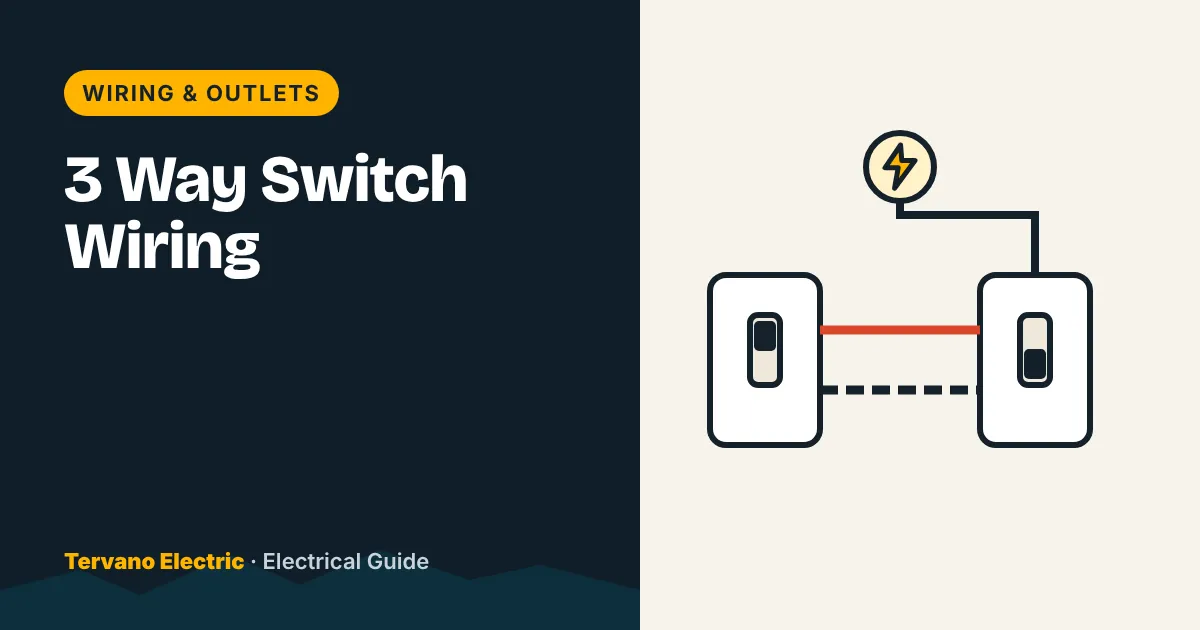
A 3 way switch lets you turn one light on or off from two locations, such as the top and bottom of a stairway. Each 3 way switch has one common terminal and two traveler terminals. Two traveler wires run between the switches, the hot feeds one common terminal, and the other common feeds the light.
Safety first. Turn off the breaker and confirm the power is off with a non-contact tester at every box before touching a wire. 3 way circuits often have more than one cable in a box, and a box can stay live from another circuit.
You replaced the switch at the bottom of the stairs. Now the hallway light only works when the upstairs switch is up. Flip it down and nothing happens, no matter what you do downstairs. Nothing is broken. One wire is on the wrong screw.
This guide explains how 3 way switch wiring works, how to read the terminals, the two most common wiring layouts with diagrams, how 4 way switches fit in, and how to fix the problems people run into. If you would rather have it done right the first time, see our electrical wiring service.
What is a 3 way switch?
A 3 way switch is a light switch that works in pairs to control one light or group of lights from two places. Unlike a regular switch, it has no ON or OFF markings, because either position can turn the light on depending on the other switch.
The name comes from its three terminals, not the number of switches. Stairways, long hallways, garages with two doors and large rooms with two entrances usually use them.
3 way switch vs single pole: what is the difference?
A single pole switch has two terminals and turns a light on or off from one place. A 3 way switch has three terminals and must work with a second 3 way switch.
| Feature | Single pole switch | 3 way switch | 4 way switch |
|---|---|---|---|
| Terminals (plus ground) | 2 | 3 (1 common, 2 travelers) | 4 (2 pairs of travelers) |
| ON/OFF printed on toggle | Yes | No | No |
| Locations controlled | 1 | 2 (used in pairs) | Adds a 3rd, 4th or more |
| Cable between switches | None | 3-wire with ground (14/3 or 12/3) | 3-wire with ground on each side |
| Typical use | Most rooms | Stairs, halls, two-door rooms | Long halls, rooms with 3+ doors |
How we built this table: it compares standard residential toggle switches by terminal count and use. To tell a switch apart without the label, count the screws. Three colored screws plus a green ground means a 3 way switch.
What do the terminals on a 3 way switch do?
The common terminal is usually the darker screw, often black or copper. The two traveler terminals are the lighter brass screws. The green screw is ground.
- Common (dark screw): connects to the incoming hot at one switch and to the wire going to the light at the other switch.
- Travelers (two brass screws): connect to the two traveler wires that run between the switches. Either traveler can go on either brass screw.
- Ground (green screw): connects to the bare or green ground wire.
The most common mistake is putting the common wire on a traveler screw. Before you remove an old switch, mark the wire on the dark screw with tape.
How does a 3 way switch work?
Each 3 way switch connects its common terminal to one traveler or the other. When both switches connect to the same traveler, current flows and the light is on. When they connect to different travelers, the path is broken and the light is off.
- Power arrives at the common terminal of the first switch.
- The first switch sends it down traveler A or traveler B.
- The second switch picks up traveler A or B and connects it to its common.
- If both switches are on the same traveler, the circuit is complete and the light turns on.
- Flipping either switch moves to the other traveler and turns the light off.
3 way switch wiring diagram: power at the first switch
This is the most common layout in newer homes. Power from the panel comes into the first switch box, a 3-wire cable runs between the switches, and a 2-wire cable runs from the second switch to the light.
What if the power comes in at the light?
In many older homes the power arrives at the light fixture first. Then a 2-wire cable runs down to one switch, and the white wire in that cable is used as a hot. It must be marked with black or red tape at both ends. The layout works the same way, it just uses the cables differently.
How to wire a 3 way switch, step by step
Replacing an existing 3 way switch is mostly about getting the common wire on the right screw. New circuits need the right cable and, in most areas, a permit.
- Turn off the breaker and test every wire in both boxes.
- Find the common wire on the old switch. It is on the dark screw. Tape it.
- Note the two travelers on the brass screws.
- Connect the common to the dark screw on the new switch.
- Connect the travelers to the two brass screws, in either order.
- Connect the ground to the green screw.
- Fold the wires in, mount the switch and restore power.
- Test every combination of both switches.
Use 14 AWG wire on 15 amp lighting circuits and 12 AWG on 20 amp circuits. Our wire size and amp chart covers the details.
How does 4 way switch wiring work?
A 4 way switch goes between two 3 way switches to add a third control location. It has four terminals, two pairs of travelers. Each position either passes the travelers straight through or crosses them.
You can add as many 4 way switches in the middle as you need. The two ends are always 3 way switches.
Can you use a dimmer or smart switch on a 3 way circuit?
Yes, with the right parts. A standard 3 way dimmer replaces one of the two switches, and the other stays a regular 3 way switch. Multi-location dimmers and smart switches use a main unit plus companion switches made by the same brand.
| Option | How it works | Watch out for |
|---|---|---|
| One 3 way dimmer | Replaces one switch, the other stays standard | Only one standard dimmer per circuit |
| Multi-location dimmer | Main dimmer plus matching companions | Companions must be the same brand |
| Smart 3 way kit | Smart main switch plus a companion or wireless remote | Most need a neutral wire in the box |
| LED bulbs | Work with LED-rated dimmers | Flicker with old incandescent dimmers |
How we built this table: it summarizes common 3 way upgrade options for homes. Follow the maker's wiring diagram, since companion switches are not interchangeable between brands. If LEDs flicker after the swap, read why your lights flicker.
Why does a smart switch need a neutral?
Smart switches stay powered to run their radio. Most need the white neutral wire in the box. The NEC has required a neutral at most new switch locations for years, but many older homes do not have one.
Why is my 3 way switch not working?
If a 3 way light only works in some switch positions, the common wire is almost always on a traveler screw. Other causes are a loose wire, a failed switch or a bad bulb.
| Symptom | Likely cause | Fix |
|---|---|---|
| Works only when the other switch is in one position | Common wire on a traveler screw | Move the common to the dark screw |
| Neither switch works | Tripped breaker, bad bulb or loose hot | Check the breaker and bulb, then the connections |
| Light flickers when the switch is touched | Loose terminal or backstab connection | Move wires to the side screws and tighten |
| Breaker trips when switched | Hot touching ground or a miswired traveler | Turn off and recheck the wiring |
| Switch feels warm | Loose connection or overloaded dimmer | Turn off and call an electrician |
How we built this table: it lists the problems homeowners run into most on 3 way circuits. Warm switches and tripping breakers point to a fault that needs a pro, and our electrical troubleshooting service can track it down. For other tripping, see why a breaker keeps tripping.
What mistakes should you avoid?
- Not marking the common wire before removing the old switch.
- Switching the neutral. The white neutral must never go to a switch terminal.
- Leaving a re-purposed white wire unmarked. Tape it black or red.
- Using backstab holes. Side screws hold better.
- Mixing companion switches from different brands.
- Skipping the ground. Every metal box and switch needs it.
Not sure which breaker controls the light? Our breaker box guide shows how to find it. Planning new fixtures too? See our lighting installation service.
3 way switch giving you trouble?
In Twin Falls or the Magic Valley? Tervano Electric wires and repairs 3 way and 4 way switches, dimmers and smart switches. Request an estimate or call (208) 719-5016.
3 way switch wiring: frequently asked questions
What is a 3 way switch?
A 3 way switch is a light switch used in pairs to control one light from two places. It has one common terminal and two traveler terminals, and no ON or OFF markings.
How do you wire a 3 way switch?
Connect the incoming hot to the common terminal of the first switch, run two travelers between the brass terminals of both switches, and connect the common of the second switch to the light. Ground both switches.
Which wire goes on the black screw of a 3 way switch?
The common wire goes on the dark screw. At one switch it is the hot from the panel, and at the other it is the wire going to the light.
Does it matter which traveler goes on which brass screw?
No. The two travelers can go on either brass screw. What matters is that the common wire is on the dark screw.
What is the difference between a 3 way and a 4 way switch?
A 3 way switch has three terminals and is used at the two ends of a circuit. A 4 way switch has four terminals and goes between two 3 way switches to add more control points.
Why does my 3 way switch only work sometimes?
The common wire is most likely on a traveler screw. Move it to the dark common screw and the light will work from both switches.
Can I use a smart switch on a 3 way circuit?
Yes, with a smart 3 way kit that includes a main switch and a companion or remote. Most smart switches need a neutral wire in the box.
What should you do next?
3 way switch wiring looks confusing because of the extra wires, but the rule is simple. Hot to the common at one end, two travelers between the switches, and the common at the other end to the light. Remember the hallway light that only worked with the upstairs switch up? Moving one wire from a brass screw to the dark screw fixes it.
Here is the order to follow:
- Turn off the breaker and test every box.
- Mark the common wire before you remove anything.
- Match the new switch: common to dark, travelers to brass, ground to green.
- Test every switch combination before closing up.
- Call a licensed electrician for new runs, missing neutrals or smart upgrades.
Where in your home would a 3 way switch make life easier? Tell us in the comments. In Twin Falls or the Magic Valley, contact Tervano Electric for help.
Can you tell which screw is the common on the switch at the top of your stairs?
Sources: NFPA 70: National Electrical Code · Electrical Safety Foundation International · U.S. Consumer Product Safety Commission.
Need an Electrician in Twin Falls?
Licensed, insured, permitted. Written estimate before work starts.
📞 (208) 719-5016Get an Estimate