
How to Wire a Light Switch: Single Pole Wiring Diagrams, Steps and Fixes
A single pole light switch has two screws and a ground. Here is how to wire one, read the two common wiring layouts and fix a switch that sparks, buzzes or does nothing.
 By Clement James, Tervano Electric · Twin Falls, Idaho · November 2026
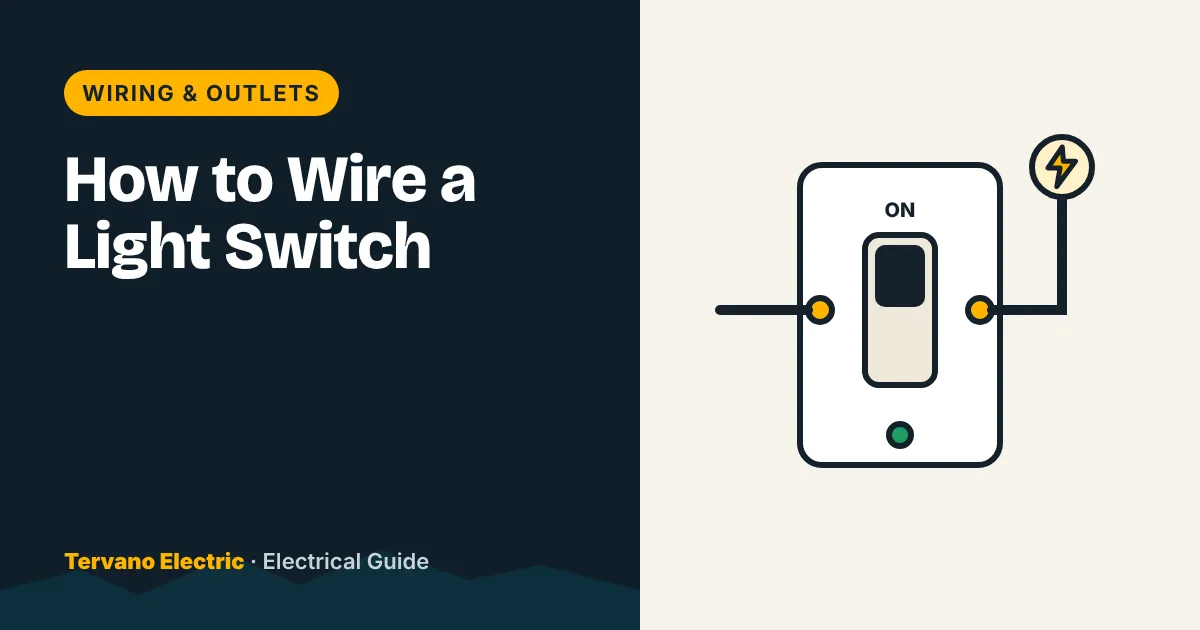
To wire a single pole light switch, turn off the breaker, connect the incoming hot wire to one brass screw, the wire going to the light to the other brass screw, and the bare or green ground to the green screw. Neutral wires never go on the switch. They are spliced together in the back of the box.
Safety first. Turn off the breaker and check every wire in the box with a non-contact tester before you touch anything. A switch box can hold wires from more than one circuit. If the wiring does not match what you expect, stop and call a licensed electrician.
The hallway switch cracked, and a new one costs a few dollars. You pull the old switch out and find two black wires, a bundle of whites in the back and a bare copper wire. Or maybe you find a white wire on the switch and wonder if that is right.
This guide shows how to wire a light switch the right way, with diagrams for the two most common layouts, the steps to replace one, how dimmers and smart switches change things, and what to do when a switch fails. If you are adding new lights or switches, see our lighting installation service.
What is a single pole light switch?
A single pole switch turns a light on or off from one location. It has two brass terminal screws and a green ground screw, and the toggle is marked ON and OFF. It is the most common switch in any home.
| Switch type | Terminals | Controls a light from | Neutral needed |
|---|---|---|---|
| Single pole | 2 brass + ground | One location | No |
| 3 way | 1 common + 2 travelers + ground | Two locations | No |
| Standard dimmer | 2 wires or screws + ground | One location | Usually no |
| Smart switch | Line, load, neutral + ground | One location plus app | Usually yes |
How we built this table: it compares common residential switches by terminals and wiring needs. Always follow the switch instructions. To control one light from two places, see our 3 way switch wiring guide.
What do the wire colors in a switch box mean?
In most homes, black is hot, white is neutral and bare copper or green is ground. Red is a second hot, often a switched leg or a traveler. A white wire with black tape is being used as a hot.
- Black: hot. One black brings power in, another may carry switched power to the light.
- White: neutral, spliced together and never connected to a standard switch.
- White with black or red tape: re-marked as a hot, common in switch loops.
- Red: a second hot, used for switched outlets, fans or 3 way travelers.
- Bare or green: ground, connected to the green screw and the box if it is metal.
Light switch wiring diagram: power at the switch
In this layout, power from the panel comes into the switch box first. A 2-wire cable then runs from the switch to the light. Most newer homes are wired this way.
Light switch wiring diagram: power at the light (switch loop)
In many older homes, power goes to the ceiling box first and a single 2-wire cable drops down to the switch. This is called a switch loop. There is no neutral in the switch box.
Do light switches need a neutral?
A standard switch does not use the neutral. The NEC now requires a neutral at most new switch locations so smart switches can be added later, but many older homes with switch loops do not have one.
How to wire a light switch when replacing an old one
Replacing a single pole switch takes about 15 minutes, and knowing how to wire a light switch makes it simple. Most of the time it takes to replace a light switch goes into checking the power is off and noting which wires go where.
- Turn off the breaker for the light. Our breaker box guide shows how to find it.
- Remove the cover plate and unscrew the switch from the box.
- Test every wire with a non-contact tester.
- Take a photo of the wiring before you disconnect anything.
- Disconnect the old switch. Note which wires were on the brass screws.
- Connect the ground to the green screw on the new switch.
- Connect the two hot wires to the brass screws. On a standard switch, either wire can go on either screw.
- Tighten the screws clockwise around the wire loop.
- Fold the wires neatly into the box and mount the switch, ON at the top.
- Restore power and test the switch.
Use the side screws instead of the push-in holes on the back. Push-in connections loosen over time and are a common cause of flickering and warm switches.
How to wire a light switch with 2 black wires
This is the classic power-at-the-switch layout. One black is the incoming hot and the other goes to the light. On a standard single pole switch, each black goes on one brass screw, in any order.
Can you wire a light switch from an outlet?
Yes, it can be done, but it is new circuit work. The outlet circuit must have spare capacity, the box must have room for the extra wires, and many areas require a permit. A switch fed from an outlet also puts the light on that outlet's breaker.
| Check | Why it matters |
|---|---|
| Circuit load | The new light adds to whatever is already on that breaker |
| Wire size | 14 AWG on a 15 amp circuit, 12 AWG on a 20 amp circuit |
| Box fill | Too many wires in a box causes heat and loose connections |
| GFCI or AFCI | Extending some circuits brings current code protection into play. See AFCI breakers |
| Permit | Adding a new switched light is new wiring in most areas |
How we built this table: it lists the checks an electrician makes before tapping an existing outlet. See our wire size and amp chart and our outlet installation service for help.
How do you wire a dimmer switch?
A single pole dimmer wires the same way as a standard switch. The two hot wires connect to the dimmer's two leads or screws, and the ground connects to green. Many smart dimmers also need the neutral.
- Match the bulbs. Use an LED-rated dimmer with dimmable LED bulbs.
- Check the wattage rating. Stay under the dimmer's maximum load.
- Expect slight warmth. Dimmers get warm in normal use, but not hot.
- Use wire connectors sized for the dimmer leads and the house wire.
If LED lights flicker after you add a dimmer, read why your lights flicker.
Why is my light switch not working?
When a light switch is not working, start with the bulb and the breaker. Then look for a loose wire, a worn switch or a problem at the fixture.
| Symptom | Likely cause | What to do |
|---|---|---|
| Nothing happens | Bulb out, tripped breaker or tripped GFCI | Check the bulb, the panel and nearby GFCI outlets |
| Works sometimes | Loose wire or worn switch | Turn off power and check the connections |
| Sparks when flipped | A tiny flash can be normal. Big sparks or popping are not | Stop using it and replace the switch |
| Switch is hot to touch | Loose connection or overloaded dimmer | Turn off the breaker and call an electrician |
| Buzzing | Dimmer with the wrong bulbs, or a loose connection | Match bulbs to the dimmer, check connections |
How we built this table: it lists the switch problems homeowners report most. Heat, burning smells and repeated sparking are warning signs of a failing connection. Our electrical troubleshooting service can find the cause.
What mistakes should you avoid?
- Skipping the tester. A box can be fed by more than one circuit.
- Putting a white neutral on the switch. It leaves the fixture live when off.
- Leaving a re-purposed white unmarked. Tape it black at both ends.
- Using push-in holes instead of side screws.
- Overfilling the box with extra wires and connectors.
- Ignoring a hot or buzzing switch. It points to a loose connection.
Switch or light giving you trouble?
In Twin Falls or the Magic Valley? Tervano Electric replaces switches, adds dimmers and smart switches, and fixes lights that act up. Request an estimate or call (208) 719-5016.
How to wire a light switch: frequently asked questions
How do you wire a light switch?
Turn off the breaker, connect the incoming hot to one brass screw and the wire to the light to the other, and connect the ground to the green screw. Neutral wires are spliced together in the box, not connected to the switch.
Does it matter which wire goes on which screw of a light switch?
On a standard single pole switch, no. Either hot wire can go on either brass screw. Smart switches and some dimmers have marked line and load terminals that must be followed.
How do you wire a light switch with 2 black wires?
Put one black wire on each brass screw and the ground on the green screw. One black brings power in and the other carries it to the light.
Why is there a white wire on my light switch?
In a switch loop, the white wire carries hot power down to the switch. It should be marked with black tape to show it is not a neutral.
Do light switches need a neutral wire?
Standard switches do not. Smart switches usually do. The NEC requires a neutral at most new switch locations, but older homes often lack one.
Why is my light switch hot to the touch?
A dimmer can feel warm, but a hot switch usually means a loose connection or an overloaded dimmer. Turn off the breaker and have it checked.
How long does it take to replace a light switch?
About 15 minutes for a simple single pole switch, once the power is off and tested. Smart switches and switch loops take longer.
What should you do next?
Learning how to wire a light switch is one of the simpler electrical skills in a home, as long as you respect the power and know which wires are which. Two hots on the brass screws, ground on green, neutrals spliced in the back. Remember the cracked hallway switch with two black wires and a bundle of whites? That is the easiest layout there is, and now you know what each wire does.
Here is the order to follow:
- Turn off the breaker and test every wire.
- Photograph the old wiring before removing it.
- Identify the layout: power at the switch or a switch loop.
- Use the side screws and tighten them well.
- Call a licensed electrician for new switches, smart switch neutrals or anything that gets hot.
What switch are you planning to replace first? Tell us in the comments. In Twin Falls or the Magic Valley, contact Tervano Electric for help.
Does your switch box have a neutral wire for a future smart switch?
Sources: NFPA 70: National Electrical Code · Electrical Safety Foundation International · U.S. Consumer Product Safety Commission.
Need an Electrician in Twin Falls?
Licensed, insured, permitted. Written estimate before work starts.
📞 (208) 719-5016Get an Estimate