
Romex Wire Guide: What 14/2 and 12/2 Mean, Color Codes, Amp Ratings and Where You Can Use It
Romex is the cable inside most home walls. Here is how to read the label, what each jacket color means and the rules for where it can go.
 By Clement James, Tervano Electric · Twin Falls, Idaho · November 2026
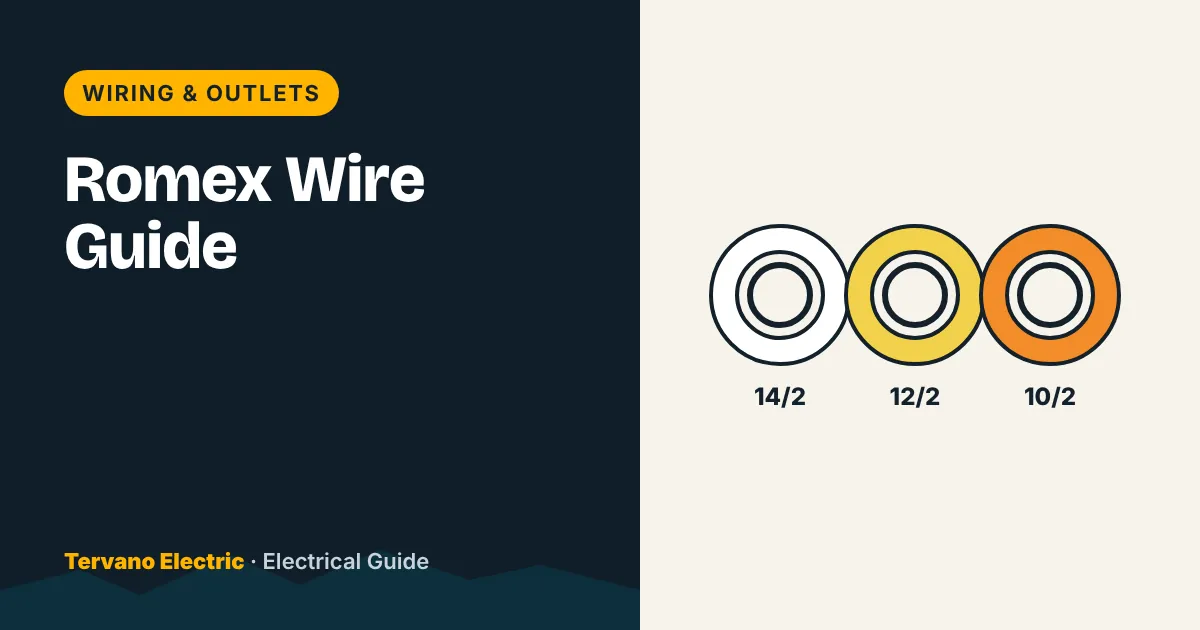
Romex is a brand name for NM-B cable, the plastic-sheathed wire used in most home walls. The first number is the wire gauge and the second is how many insulated conductors it holds, plus a bare ground. 14/2 is rated for 15 amps, 12/2 for 20 amps and 10/2 for 30 amps. NM-B is for dry indoor locations only.
Safety first. Cable size must match the breaker. A wire that is too small for its breaker can overheat inside the wall before the breaker trips. Adding new circuits usually requires a permit and inspection.
You are standing in the electrical aisle looking at rolls of white, yellow and orange cable. The labels say 14/2, 12/2 and 12/3, and the prices are very different. You need to run a circuit to the garage and want to buy the right one the first time.
This guide explains what Romex is, how to read the numbers, what the jacket colors mean, the amp rating of each size, and the rules for where it can and cannot be installed. For new circuits done right, see our electrical wiring service.
What is Romex wire?
Romex is Southwire's brand name for nonmetallic sheathed cable, called NM-B in the electrical code. It bundles two or three insulated copper conductors and a bare copper ground inside a flexible plastic jacket. People use "Romex" for any NM-B cable, the way they say "Kleenex" for tissues.
The "B" means the conductors are rated for 90 degrees Celsius. Even so, the code limits NM-B ampacity to the 60 degree column, which is why its amp ratings look conservative.
What does 14/2 and 12/2 mean?
The first number is the American Wire Gauge (AWG) size of the conductors. Smaller numbers are thicker wire. The second number counts the insulated conductors, not including the bare ground. "With ground" or "W/G" confirms a bare ground is included.
When do you need /3 cable?
Use /3 when a circuit needs a second hot wire. Common uses are 3 way switches, ceiling fans with separate light control, split kitchen receptacles and 240 volt appliances with a neutral, like many ranges and dryers. See our 3 way switch wiring guide.
What do the Romex wire colors mean?
The jacket color shows the wire gauge at a glance, so inspectors and electricians can check it without reading the print. This color code is standard on Southwire cable and widely used by other makers.
| Jacket color | Wire size | Amp rating (NM-B) | Common uses |
|---|---|---|---|
| White | 14 AWG | 15 A | Lighting and general outlet circuits |
| Yellow | 12 AWG | 20 A | Kitchen, bath, laundry and garage outlets |
| Orange | 10 AWG | 30 A | Water heaters, dryers, small AC units |
| Black | 8 AWG and 6 AWG | 40 A and 55 A | Ranges, cooktops, subpanels, EV chargers |
| Gray | Any size (UF-B) | Varies by size | Underground and wet locations |
How we built this table: jacket colors follow the industry color code for NM-B and UF-B cable. Amp ratings use the NEC 60 degree Celsius column that applies to NM-B cable. Always confirm the size printed on the jacket. Our wire size and amp chart covers other wire types and long runs.
What is the amp rating of Romex wire?
NM-B cable is limited to its 60 degree rating. That means 14 AWG for 15 amps, 12 AWG for 20 amps and 10 AWG for 30 amps. Matching the breaker to these ratings keeps the cable from overheating.
- 14/2: 15 amp circuits, usually lights and bedroom outlets.
- 12/2: 20 amp circuits, required for kitchen countertop, bathroom and laundry outlets.
- 10/2: 30 amp circuits, such as a water heater. See water heater breaker size.
- 10/3: 30 amp circuits that need a neutral, like most dryers.
- 6/3 and 8/3: ranges, cooktops and many EV chargers.
Long runs can need a larger size to limit voltage drop. Shops and outbuildings are where that comes up most. See our shop and garage electrical service.
NM-B vs UF-B vs THHN: what is the difference?
NM-B is for dry locations inside buildings. UF-B is a tougher cable rated for wet locations and direct burial. THHN is a single insulated wire meant to be pulled through conduit.
| Type | What it is | Where it goes | Jacket |
|---|---|---|---|
| NM-B (Romex) | Sheathed cable with 2 or 3 conductors and ground | Dry indoor locations, inside walls, floors and ceilings | Colored by gauge, flexible |
| UF-B | Solid-molded cable for wet use | Underground, outdoors and wet locations | Gray, solid filler |
| THHN/THWN | Single insulated conductors | Inside conduit, including wet locations if THWN rated | Individual colored wires |
How we built this table: it compares the cable types homeowners see most, based on their NEC listings. Check the print on the jacket for the exact rating before you buy.
Where can you use Romex, and where can you not?
Romex is meant for concealed, dry locations in homes and some light commercial buildings. It cannot go in wet or damp places, and exposed runs must be protected from damage.
| Location | Romex allowed? | Notes |
|---|---|---|
| Inside walls, ceilings and floors | Yes | Stapled and supported per code |
| Unfinished basement or garage | Yes, with protection | Run along framing or protect where it could be damaged |
| Outdoors or underground | No | Use UF-B or conductors in conduit |
| In conduit outdoors or underground | No | Conduit in wet locations counts as wet inside |
| Short conduit sleeve for protection | Yes | Common where cable leaves a wall or enters a panel |
| Many commercial buildings | Depends | Construction type limits where NM cable is allowed |
How we built this table: it summarizes the common NM cable rules in NEC Article 334. Local amendments and the inspector have the final word.
Can Romex be run in conduit?
Yes, inside a dry building, for short sleeves or protection where the cable could be damaged. It is not allowed in conduit outdoors or underground, because those locations are wet. Fitting Romex in long conduit runs is also hard, and the cable can overheat if the conduit is too full.
How do you install Romex correctly?
- Pick the right size for the breaker and the load.
- Plan the route through framing, away from sharp edges and heat.
- Drill holes near the center of studs and joists, or protect the cable with nail plates.
- Staple within 12 inches of each box and at regular intervals along the run.
- Leave at least 6 inches of free conductor at each box.
- Keep at least 1/4 inch of sheath inside the box past the clamp.
- Use listed connectors where cable enters metal boxes and panels.
New circuits often need a permit and inspection. Our guide on how to wire a light switch shows how cables connect inside a box.
What Romex mistakes should you avoid?
- Undersized cable. 14/2 on a 20 amp breaker is a fire risk.
- Romex outdoors or underground. Use UF-B or wire in conduit.
- Stripping the jacket too far or nicking the insulation.
- Unprotected exposed runs in garages and basements.
- Overfilled boxes with too many cables.
- Using old cloth-jacketed cable as a model. Older wiring may need replacing. See knob and tube wiring.
Planning new circuits?
In Twin Falls or the Magic Valley? Tervano Electric runs new circuits, shop feeders and full home rewiring. Request an estimate or call (208) 719-5016.
Romex wire: frequently asked questions
What is Romex wire?
Romex is a brand name for NM-B nonmetallic sheathed cable. It has two or three insulated copper conductors and a bare ground inside a plastic jacket and is used for most home wiring.
What does 12/2 Romex mean?
It means 12 AWG wire with two insulated conductors, black and white, plus a bare ground. It is used for 20 amp circuits.
What size breaker for 14/2 Romex?
A 15 amp breaker. 14 AWG copper NM-B cable must not be protected by a breaker larger than 15 amps.
What do the yellow and orange Romex colors mean?
Yellow jacket Romex is 12 AWG for 20 amp circuits. Orange is 10 AWG for 30 amp circuits. White is 14 AWG and black is 8 or 6 AWG.
Can Romex be used outside?
No. NM-B is for dry locations only. Outdoors and underground, use UF-B cable or THWN conductors in conduit.
Can Romex be run in conduit?
Yes, indoors in dry locations for protection or short sleeves. It cannot be run in conduit outdoors or underground.
What is the difference between NM-B and UF-B?
NM-B is for dry indoor locations. UF-B has a solid molded gray jacket rated for wet locations and direct burial.
What should you do next?
Romex is simple once you can read it. The first number is the gauge, the second is the count of insulated wires, and the jacket color tells you the size at a glance. White is 14, yellow is 12, orange is 10. Match the cable to the breaker, keep it in dry locations and protect it where it is exposed. Back in that electrical aisle, a 20 amp garage circuit calls for yellow 12/2.
Here is the order to follow:
- Check the breaker size for the circuit.
- Choose the matching gauge from the color chart.
- Pick /2 or /3 based on whether you need a second hot.
- Use UF-B or conduit for anything outdoors or underground.
- Get a permit and have a licensed electrician handle panel connections.
What circuit are you planning to run? Tell us in the comments. In Twin Falls or the Magic Valley, contact Tervano Electric for help.
Do you know what size cable feeds your garage outlets today?
Sources: NFPA 70: National Electrical Code · Southwire, maker of Romex brand cable · Electrical Safety Foundation International.
Need an Electrician in Twin Falls?
Licensed, insured, permitted. Written estimate before work starts.
📞 (208) 719-5016Get an Estimate